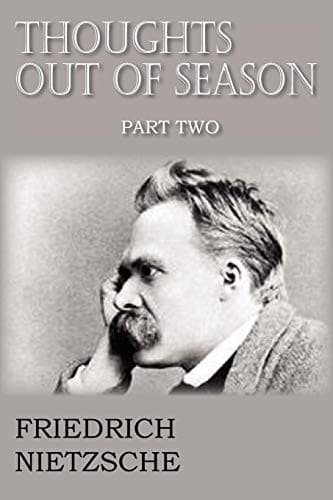
Thoughts Out of Season, Part IINietzsche, Friedrich Wilhelm
PhilosophyPhilosophy
Thoughts Out of Season, Part II
Nietzsche, Friedrich Wilhelm
History -- Study and teaching; Schopenhauer, Arthur, 1788-1860
The last hint may well remain obscure for a time: I have something
more easy to explain, namely how Schopenhauer can help us to educate
ourselves _in opposition_ to our age, since we have the advantage of
really knowing our age, through him;--if it be an advantage! It may
be no longer possible in a couple of hundred years. I sometimes amuse
myself with the idea that men may soon grow tired of books and their
authors, and the savant of to-morrow come to leave directions in his
will that his body be burned in the midst of his books, including of
course his own writings. And in the gradual clearing of the forests,
might not our libraries be very reasonably used for straw and
brushwood? Most books are born from the smoke and vapour of the
brain: and to vapour and smoke may they well return. For having no
fire within themselves, they shall be visited with fire. And possibly
to a later century our own may count as the "Dark age," because our
productions heated the furnace hotter and more continuously than ever
before. We are anyhow happy that we can learn to know our time; and
if there be any sense in busying ourselves with our time at all, we
may as well do it as thoroughly as we can, so that no one may have
any doubt about it. The possibility of this we owe to Schopenhauer.
Our happiness would of course be infinitely greater, if our inquiry
showed that nothing so hopeful and splendid as our present epoch had
ever existed. There are simple people in some corner of the earth
to-day--perhaps in Germany--who are disposed to believe in all
seriousness that the world was put right two years ago,[1] and that
all stern and gloomy views of life are now contradicted by "facts."
The foundation of the New German Empire is, to them, the decisive
blow that annihilates all the "pessimistic" philosophisers,--no doubt
of it. To judge the philosopher's significance in our time, as an
educator, we must oppose a widespread view like this, especially
common in our universities. We must say, it is a shameful thing that
such abominable flattery of the Time-Fetish should be uttered by a
herd of so-called reflective and honourable men; it is a proof that
we no longer see how far the seriousness of philosophy is removed
from that of a newspaper. Such men have lost the last remnant of
feeling, not only for philosophy, but also for religion, and have put
in its place a spirit not so much of optimism as of journalism, the
evil spirit that broods over the day--and the daily paper. Every
philosophy that believes the problem of existence to be shelved, or
even solved, by a political event, is a sham philosophy. There have
been innumerable states founded since the beginning of the world;
that is an old story. How should a political innovation manage once
and for all to make a contented race of the dwellers on this earth?
If any one believe in his heart that this is possible, he should
report himself to our authorities: he really deserves to be Professor
Public-domain text, read in full here on John Shaqi.
Reviews
Reviews
No reviews yet
Be the first to share your thoughts on this work.
Elsewhere in the archive
Join the Discussion
Join the discussion
Sign in to leave a comment or review.
Sign InorCreate an account