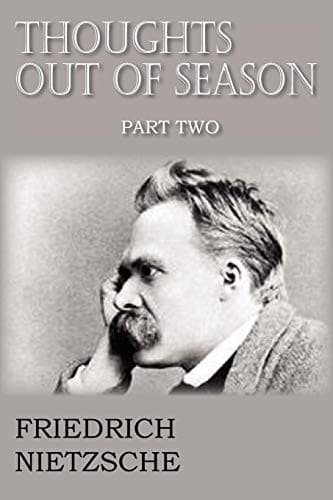
Thoughts Out of Season, Part IINietzsche, Friedrich Wilhelm
PhilosophyPhilosophy
Thoughts Out of Season, Part II
Nietzsche, Friedrich Wilhelm
History -- Study and teaching; Schopenhauer, Arthur, 1788-1860
dancers whirl round, and the heart of the wanderer is shaken within
him to see it: everything is so disordered, so drab, so hopeless.
Even now there is a sound of joy, of clear thoughtless joy! but soon
the mist of evening closes round, the note dies away, and the
wanderer's footsteps are heard on the gravel; as far as his eye can
reach there is nothing but the grim and desolate face of nature.
It may be one-sided, to insist only on the blurred lines and the dull
colours in the picture of modern life: yet the other side is no more
encouraging, it is only more disturbing. There is certainly strength
there, enormous strength; but it is wild, primitive and merciless.
One looks on with a chill expectancy, as though into the caldron of a
witch's kitchen; every moment there may arise sparks and vapour, to
herald some fearful apparition. For a century we have been ready for
a world-shaking convulsion; and though we have lately been trying to
set the conservative strength of the so-called national state against
the great modern tendency to volcanic destructiveness, it will only
be, for a long time yet, an aggravation of the universal unrest that
hangs over us. We need not be deceived by individuals behaving as if
they knew nothing of all this anxiety: their own restlessness shows
how well they know it. They think more exclusively of themselves than
men ever thought before; they plant and build for their little day,
and the chase for happiness is never greater than when the quarry
must be caught to-day or to-morrow: the next day perhaps there is no
more hunting. We live in the Atomic Age, or rather in the Atomic
Chaos. The opposing forces were practically held together in mediæval
times by the Church, and in some measure assimilated by the strong
pressure which she exerted. When the common tie broke and the
pressure relaxed, they rose once more against each other. The
Reformation taught that many things were "adiaphora"--departments
that needed no guidance from religion: this was the price paid for
its own existence. Christianity paid a similar one to guard itself
against the far more religious antiquity: and laid the seeds of
discord at once. Everything nowadays is directed by the fools and the
knaves, the selfishness of the money-makers and the brute forces of
militarism. The state in their hands makes a good show of
reorganising everything, and of becoming the bond that unites the
warring elements; in other words, it wishes for the same idolatry
from mankind as they showed to the Church.
And we shall yet feel the consequences. We are even now on the
ice-floes in the stream of the Middle Ages: they are thawing fast,
and their movement is ominous: the banks are flooded, and giving way.
The revolution, the atomistic revolution, is inevitable: but what
_are_ those smallest indivisible elements of human society?
Public-domain text, read in full here on John Shaqi.
Reviews
Reviews
No reviews yet
Be the first to share your thoughts on this work.
Elsewhere in the archive
Join the Discussion
Join the discussion
Sign in to leave a comment or review.
Sign InorCreate an account