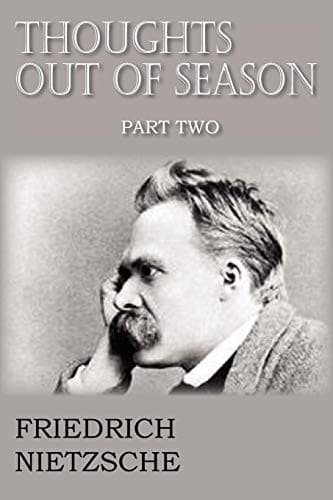
Thoughts Out of Season, Part IINietzsche, Friedrich Wilhelm
PhilosophyPhilosophy
Thoughts Out of Season, Part II
Nietzsche, Friedrich Wilhelm
History -- Study and teaching; Schopenhauer, Arthur, 1788-1860
Goethe's man is no such threatening force; in a certain sense he is a
corrective and a sedative to those dangerous agitations of which
Rousseau's man is a prey. Goethe himself in his youth followed the
"gospel of kindly Nature" with all the ardour of his soul: his Faust
was the highest and boldest picture of Rousseau's man, so far at any
rate as his hunger for life, his discontent and yearning, his
intercourse with the demons of the heart could be represented. But
what comes from these congregated storm-clouds? Not a single
lightning flash! And here begins the new Image of man--the man
according to Goethe. One might have thought that Faust would have
lived a continual life of suffering, as a revolutionary and a
deliverer, as the negative force that proceeds from goodness, as the
genius of ruin, alike religious and dæmonic, in opposition to his
utterly undæmonic companion; though of course he could not be free of
this companion, and had at once to use and despise his evil and
destructive scepticism--which is the tragic destiny of all
revolutionary deliverers. One is wrong, however, to expect anything
of the sort: Goethe's man here parts company with Rousseau's; for he
hates all violence, all sudden transition--that is, all action: and
the universal deliverer becomes merely the universal traveller. All
the riches of life and nature, all antiquity--arts, mythologies and
sciences--pass before his eager eyes, his deepest desires are aroused
and satisfied, Helen herself can hold him no more--and the moment
must come for which his mocking companion is waiting. At a fair spot
on the earth, his flight comes to an end: his pinions drop, and
Mephistopheles is at his side. When the German ceases to be Faust,
there is no danger greater than of becoming a Philistine and falling
into the hands of the devil--heavenly powers alone can save him.
Goethe's man is, as I said, the contemplative man in the grand style,
who is only kept from dying of ennui by feeding on all the great and
memorable things that have ever existed, and by living from desire to
desire. He is not the active man; and when he does take a place among
active men, as things are, you may be sure that no good will come of
it (think, for example, of the zeal with which Goethe wrote for the
stage!); and further, you may be sure that "things as they are" will
suffer no change. Goethe's man is a conciliatory and conservative
spirit, though in danger of degenerating into a Philistine, just as
Rousseau's man may easily become a Catiline. All his virtues would be
the better by the addition of a little brute force and elemental
passion. Goethe appears to have seen where the weakness and danger of
his creation lay, as is clear from Jarno's word to Wilhelm Meister:
"You are bitter and ill-tempered--which is quite an excellent thing:
if you could once become really angry, it would be still better."
Public-domain text, read in full here on John Shaqi.
Reviews
Reviews
No reviews yet
Be the first to share your thoughts on this work.
Elsewhere in the archive
Join the Discussion
Join the discussion
Sign in to leave a comment or review.
Sign InorCreate an account