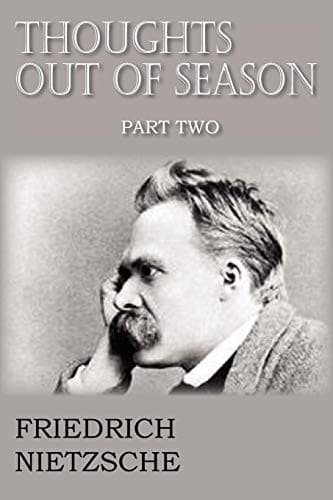
Thoughts Out of Season, Part IINietzsche, Friedrich Wilhelm
PhilosophyPhilosophy
Thoughts Out of Season, Part II
Nietzsche, Friedrich Wilhelm
History -- Study and teaching; Schopenhauer, Arthur, 1788-1860
The deeper minds of all ages have had pity for animals, because they
suffer from life and have not the power to turn the sting of the
suffering against themselves, and understand their being
metaphysically. The sight of blind suffering is the spring of the
deepest emotion. And in many quarters of the earth men have supposed
that the souls of the guilty have entered into beasts, and that the
blind suffering which at first sight calls for such pity has a clear
meaning and purpose to the divine justice,--of punishment and
atonement: and a heavy punishment it is, to be condemned to live in
hunger and need, in the shape of a beast, and to reach no
consciousness of one's self in this life. I can think of no harder
lot than the wild beast's; he is driven to the forest by the fierce
pang of hunger, that seldom leaves him at peace; and peace is itself
a torment, the surfeit after horrid food, won, maybe, by a deadly
fight with other animals. To cling to life, blindly and madly, with
no other aim, to be ignorant of the reason, or even the fact, of
one's punishment, nay, to thirst after it as if it were a pleasure,
with all the perverted desire of a fool--this is what it means to be
an animal. If universal nature leads up to man, it is to show us that
he is necessary to redeem her from the curse of the beast's life, and
that in him existence can find a mirror of itself wherein life
appears, no longer blind, but in its real metaphysical significance.
But we should consider where the beast ends and the man begins--the
man, the one concern of Nature. As long as any one desires life as a
pleasure in itself, he has not raised his eyes above the horizon of
the beast; he only desires more consciously what the beast seeks by a
blind impulse. It is so with us all, for the greater part of our
lives. We do not shake off the beast, but are beasts ourselves,
suffering we know not what.
Public-domain text, read in full here on John Shaqi.
Reviews
Reviews
No reviews yet
Be the first to share your thoughts on this work.
Elsewhere in the archive
Join the Discussion
Join the discussion
Sign in to leave a comment or review.
Sign InorCreate an account