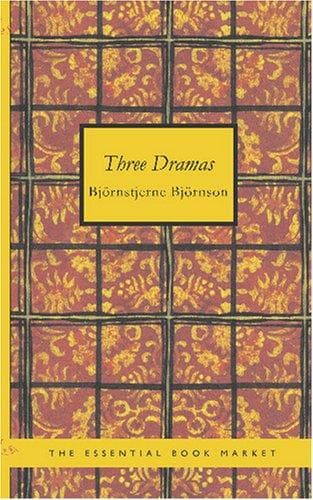
Bjørnson, Bjørnstjerne, 1832-1910 -- Translations into English; Drama
The King. I can feel that when I read it. If only I had been allowed to
read it in those days! Do you remember how in it your father maintains,
too, that all reform depends on the beating down of the hedge that
surrounds royalty?--on a king's becoming, as he says, "wedded to
his people" in the fullest sense of the word, not irregularly or
surreptitiously? No king can share his people's thoughts if he lives
apart from them in a great palace, married to a foreign princess. There
is no national spirit behind a complicated court life of outlandish
ceremonial.
Clara (turning away her head). You should have heard how vehemently my
father used to assert those ideas.
The King. And yet he abandoned them.
Clara. Became a republican, you mean?
The King. Yes.
Clara. He was so disappointed. (A pause.)
The King. I sometimes wonder every one isn't a republican! It must come
to that in the end; I can see that. If only royalties nowadays thought
seriously enough about it to realise it!
Clara. It is made so difficult for them by those who surround them.
The King. Yes, you see, that is another reason why any such reform must
begin at home. Do you think that a king, who went every day to his work
from a home that was in every respect like that of one of his people,
could fail in the long run?
Clara. There are so many different kinds of homes.
The King. I mean a home that holds love instead of subservience--comfort
instead of ceremony-truth instead of flattery; a home where--ah, well, I
need not teach a woman what a home means.
Clara. We make them what they are.
The King. Surely; but they are especially what women make them. (A
pause.)
Clara. The sun is quite strong now.
The King. But it can scarcely pierce through the screen of leaves here.
Clara. When the sun shines down like this and the leaves tremble--
The King. The sunshine seems to tremble too.
Clara. Yes, but it makes one feel as if everything were trembling--even
deep down into our hearts!
The King. That is true.--Yes, its homes are the most precious things a
nation makes. Their national characteristics mean reverence for their
past and possibilities for their future.
Clara. I understand better now what you meant.
The King. When I said I wanted to begin at the beginning?
Clara. Yes. (A pause.)
The King. I cannot do otherwise. My heart must be in my work.
Clara (smiling). My father had his heart in his work, too.
The King. Forgive me--but don't you think it was just the want of
an object in his life that led your father to push his theories too
far?--an object outside himself, I mean?
Clara. Perhaps. If my mother had lived--. (Stops.)
The King.--he might have taken it differently; don't you think so?
Clara. I have sometimes thought so. (A pause.)
The King. How still it is! Not a sound!
Clara. Yes, there is the fountain.
The King. That is true; but one ends by hardly hearing a continuous
sound like that.
Clara. There is a tremulousness in _that_ too. (Looks round her.)
Public-domain text, read in full here on John Shaqi.
Reviews
Reviews
No reviews yet
Be the first to share your thoughts on this work.
Elsewhere in the archive
Join the Discussion
Join the discussion
Sign in to leave a comment or review.
Sign InorCreate an account