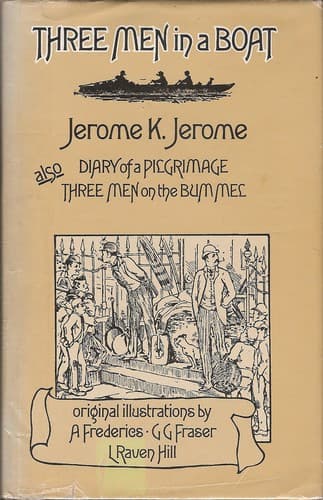
Three men on the bummelJerome, Jerome K. (Jerome Klapka)
General
Three men on the bummel
Jerome, Jerome K. (Jerome Klapka)
Bicycle touring -- Fiction; Black Forest (Germany) -- Fiction; British -- Germany -- Fiction; Humorous stories
"It must have been my fault," I answered; "my knowledge is extremely
limited. One picks up a little here and there as one goes about, but of
course that is a different thing."
"But _they_ did not understand it," he replied, "the landlord and his
wife; and it is their own language."
"I do not think so," I said. "The children hereabout speak German, it is
true, and our landlord and landlady know German to a certain point. But
throughout Alsace and Lorraine the old people still talk French."
"And I spoke to them in French also," he added, "and they understood that
no better."
"It is certainly very curious," I agreed.
"It is more than curious," he replied; "in my case it is
incomprehensible. I possess a diploma for modern languages. I won my
scholarship purely on the strength of my French and German. The
correctness of my construction, the purity of my pronunciation, was
considered at my college to be quite remarkable. Yet, when I come abroad
hardly anybody understands a word I say. Can you explain it?"
"I think I can," I replied. "Your pronunciation is too faultless. You
remember what the Scotsman said when for the first time in his life he
tasted real whisky: 'It may be puir, but I canna drink it'; so it is with
your German. It strikes one less as a language than as an exhibition. If
I might offer advice, I should say: Mispronounce as much as possible, and
throw in as many mistakes as you can think of."
It is the same everywhere. Each country keeps a special pronunciation
exclusively for the use of foreigners--a pronunciation they never dream
of using themselves, that they cannot understand when it is used. I once
heard an English lady explaining to a Frenchman how to pronounce the word
Have.
"You will pronounce it," said the lady reproachfully, "as if it were
spelt H-a-v. It isn't. There is an 'e' at the end."
"But I thought," said the pupil, "that you did not sound the 'e' at the
end of h-a-v-e."
"No more you do," explained his teacher. "It is what we call a mute 'e';
but it exercises a modifying influence on the preceding vowel."
Before that, he used to say "have" quite intelligently. Afterwards, when
he came to the word he would stop dead, collect his thoughts, and give
expression to a sound that only the context could explain.
Putting aside the sufferings of the early martyrs, few men, I suppose,
have gone through more than I myself went through in trying to I attain
the correct pronunciation of the German word for church--"Kirche." Long
before I had done with it I had determined never to go to church in
Germany, rather than be bothered with it.
Public-domain text, read in full here on John Shaqi.
Reviews
Reviews
No reviews yet
Be the first to share your thoughts on this work.
Elsewhere in the archive
Join the Discussion
Join the discussion
Sign in to leave a comment or review.
Sign InorCreate an account