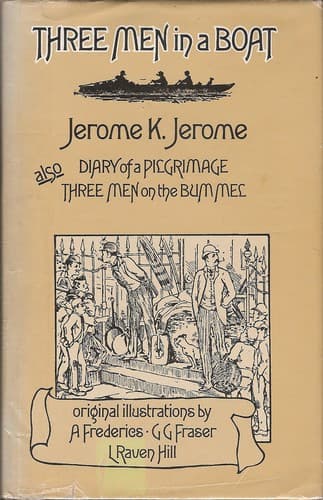
Three men on the bummelJerome, Jerome K. (Jerome Klapka)
General
Three men on the bummel
Jerome, Jerome K. (Jerome Klapka)
Bicycle touring -- Fiction; Black Forest (Germany) -- Fiction; British -- Germany -- Fiction; Humorous stories
In the placid, docile German of to-day, whose only ambition appears to be
to pay his taxes, and do what he is told to do by those whom it has
pleased Providence to place in authority over him, it is difficult, one
must confess, to detect any trace of his wild ancestor, to whom
individual liberty was as the breath of his nostrils; who appointed his
magistrates to advise, but retained the right of execution for the tribe;
who followed his chief, but would have scorned to obey him. In Germany
to-day one hears a good deal concerning Socialism, but it is a Socialism
that would only be despotism under another name. Individualism makes no
appeal to the German voter. He is willing, nay, anxious, to be
controlled and regulated in all things. He disputes, not government, but
the form of it. The policeman is to him a religion, and, one feels, will
always remain so. In England we regard our man in blue as a harmless
necessity. By the average citizen he is employed chiefly as a signpost,
though in busy quarters of the town he is considered useful for taking
old ladies across the road. Beyond feeling thankful to him for these
services, I doubt if we take much thought of him. In Germany, on the
other hand, he is worshipped as a little god and loved as a guardian
angel. To the German child he is a combination of Santa Claus and the
Bogie Man. All good things come from him: Spielplatze to play in,
furnished with swings and giant-strides, sand heaps to fight around,
swimming baths, and fairs. All misbehaviour is punished by him. It is
the hope of every well-meaning German boy and girl to please the police.
To be smiled at by a policeman makes it conceited. A German child that
has been patted on the head by a policeman is not fit to live with; its
self-importance is unbearable.
The German citizen is a soldier, and the policeman is his officer. The
policeman directs him where in the street to walk, and how fast to walk.
At the end of each bridge stands a policeman to tell the German how to
cross it. Were there no policeman there, he would probably sit down and
wait till the river had passed by. At the railway station the policeman
locks him up in the waiting-room, where he can do no harm to himself.
When the proper time arrives, he fetches him out and hands him over to
the guard of the train, who is only a policeman in another uniform. The
guard tells him where to sit in the train, and when to get out, and sees
that he does get out. In Germany you take no responsibility upon
yourself whatever. Everything is done for you, and done well. You are
not supposed to look after yourself; you are not blamed for being
incapable of looking after yourself; it is the duty of the German
policeman to look after you. That you may be a helpless idiot does not
excuse him should anything happen to you. Wherever you are and whatever
you are doing you are in his charge, and he takes care of you--good care
of you; there is no denying this.
Public-domain text, read in full here on John Shaqi.
Reviews
Reviews
No reviews yet
Be the first to share your thoughts on this work.
Elsewhere in the archive
Join the Discussion
Join the discussion
Sign in to leave a comment or review.
Sign InorCreate an account