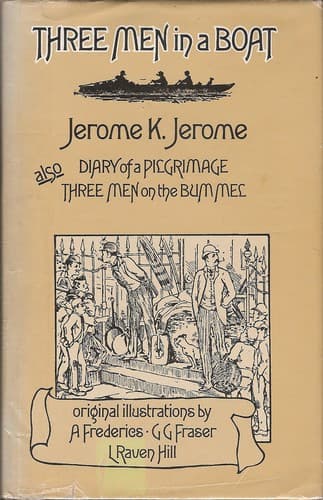
Three men on the bummelJerome, Jerome K. (Jerome Klapka)
General
Three men on the bummel
Jerome, Jerome K. (Jerome Klapka)
Bicycle touring -- Fiction; Black Forest (Germany) -- Fiction; British -- Germany -- Fiction; Humorous stories
All three of us, by some means or another, managed, between Nuremberg and
the Black Forest, to get into trouble.
Harris led off at Stuttgart by insulting an official. Stuttgart is a
charming town, clean and bright, a smaller Dresden. It has the
additional attraction of containing little that one need to go out of
one's way to see: a medium-sized picture gallery, a small museum of
antiquities, and half a palace, and you are through with the entire thing
and can enjoy yourself. Harris did not know it was an official he was
insulting. He took it for a fireman (it looked like a fireman), and he
called it a "dummer Esel."
In German you are not permitted to call an official a "silly ass," but
undoubtedly this particular man was one. What had happened was this:
Harris in the Stadgarten, anxious to get out, and seeing a gate open
before him, had stepped over a wire into the street. Harris maintains he
never saw it, but undoubtedly there was hanging to the wire a notice,
"Durchgang Verboten!" The man, who was standing near the gate stopped
Harris, and pointed out to him this notice. Harris thanked him, and
passed on. The man came after him, and explained that treatment of the
matter in such off-hand way could not be allowed; what was necessary to
put the business right was that Harris should step back over the wire
into the garden. Harris pointed out to the man that the notice said
"going through forbidden," and that, therefore, by re-entering the garden
that way he would be infringing the law a second time. The man saw this
for himself, and suggested that to get over the difficulty Harris should
go back into the garden by the proper entrance, which was round the
corner, and afterwards immediately come out again by the same gate. Then
it was that Harris called the man a silly ass. That delayed us a day,
and cost Harris forty marks.
I followed suit at Carlsruhe, by stealing a bicycle. I did not mean to
steal the bicycle; I was merely trying to be useful. The train was on
the point of starting when I noticed, as I thought, Harris's bicycle
still in the goods van. No one was about to help me. I jumped into the
van and hauled it out, only just in time. Wheeling it down the platform
in triumph, I came across Harris's bicycle, standing against a wall
behind some milk-cans. The bicycle I had secured was not Harris's, but
some other man's.
Public-domain text, read in full here on John Shaqi.
Reviews
Reviews
No reviews yet
Be the first to share your thoughts on this work.
Elsewhere in the archive
Join the Discussion
Join the discussion
Sign in to leave a comment or review.
Sign InorCreate an account