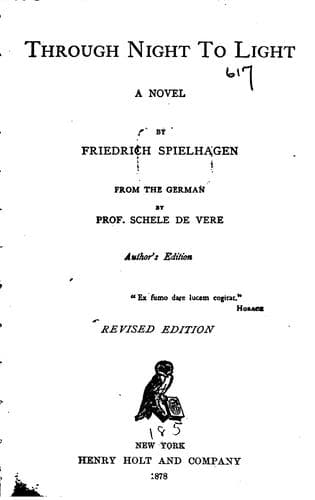
Through Night to Light: A NovelSpielhagen, Friedrich
General
Through Night to Light: A Novel
Spielhagen, Friedrich
Fiction
"For instance, if one borrows money from the Jews, and sues them
afterwards, when they want to be paid, for usury," replied Timm.
This recollection from the early life of Felix was so little to the
taste of the ex-lieutenant that he turned over impatiently in his
chair, and said in an audibly irritated tone:
"I think we had better come to the point."
"With pleasure," said Mr. Timm, drawing up his chair close to the
table, with an expression which by no means belied his words.
"You have been kind enough," began Felix, while the baroness stared
with furrowed brow and downcast eyes into her lap, "to send us, at our
request, copies of certain letters, and so forth, which you say you
have found among the papers of your deceased father."
"You mean, which you have found, baron!"
"Very well, then; which you have found. We can admit that without
committing ourselves, for there is nothing in them all to show how this
fabulous son of my uncle Harald can be helped by your aid--as you are
good enough to state in your letter--to the inheritance he may claim."
"That depends entirely upon the _point de vue_ from which you look at
the matter," replied Mr. Timm.
"And may I beg you will inform us of your own?"
"Why not? It gives me special pleasure to do so. According to my view
the thing is this: I have here a number of documents and papers, which
not only shed a light on the relations once existing between Baron
Harald and Mademoiselle Marie Montbert, but which would also, in the
hands of an able, practical man (such as any good lawyer would
represent), give a certain clue to the subsequent fate of the said
Marie Montbert and of her child; that is to say, of the two persons who
according to the last will of Baron Harald are alone entitled to the
possession of the estates of Stantow and Baerwalde."
"What do you call a certain clue, Mr. Timm?" inquired the baroness.
"A clue that can be established upon evidence, madame. It can be
established that the person to whom I have referred, and in whom I
believe I have discovered by a fortunate combination of very remarkable
and almost miraculous circumstances the heir in question, bears, in the
first place, the same name which Monsieur d'Estein (pray look at letter
No. 25) says he intends to assume after the elopement with Marie
Montbert. In the second place, it can be established that a man called
Stein, and accompanied by a young woman who passed for his wife, and by
a child which passed for his son, settled shortly after Baron Harald's
death in the town of W----."
"How do you know that?" asked Felix.
"I have been myself to W----, and have spoken with the old woman in
whose house Mr. Stein lived from the first to the very last day of his
residence in that town."
"Go on!"
"In the third place, it is established that this Mr. Stein is the same
person who eloped with Marie Montbert from Grenwitz, viz., Monsieur
d'Estein, who alone had a right to help the young lady, and who alone
was obliged to do so."
Public-domain text, read in full here on John Shaqi.
Reviews
Reviews
No reviews yet
Be the first to share your thoughts on this work.
Elsewhere in the archive
Join the Discussion
Join the discussion
Sign in to leave a comment or review.
Sign InorCreate an account