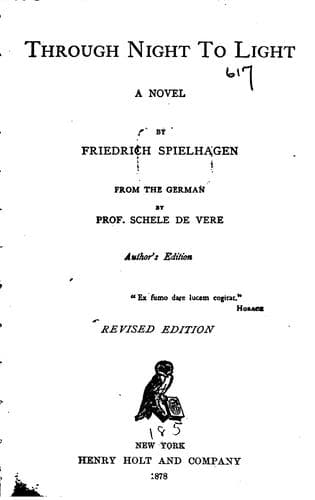
Through Night to Light: A NovelSpielhagen, Friedrich
General
Through Night to Light: A Novel
Spielhagen, Friedrich
Fiction
In former days this would have evidently been the privilege of Anna
Maria, who enjoyed strife, and felt sure of victory. But strangely
enough, husband and wife seemed recently to have exchanged parts. The
baron was almost transformed since Bruno's death and Helen's departure
from home. Formerly good-natured, yielding, and peaceful, he had become
sensitive, grumbling, and obstinate. This change might have been in
part the effect of his bad state of health and his decline, which had
become very perceptible in the last weeks; but sometimes it looked as
if the cause was a deeper one--as if the recent events had roused the
old gentleman from his lethargy, and shown him many things and many
persons in a very different light from that in which he had seen them
before. He who had formerly hardly taken a glass of water without first
consulting his Anna Maria, suddenly began to act for himself, even to
think for himself, and to have positive views of his own, which he
maintained with that obstinacy and pertinacity which is often observed
in weak minds. He had had attacks of this obstinacy in former years
also, but now the sporadic occurrences seemed to have changed into a
chronic disease. People are apt to say of somebody who acts in an
extraordinary manner, "he won't live long;" and if there is any reason
for this assertion, the days of the baron must have been numbered.
Perhaps this was really so, and the baron suspected it secretly, so
that he made unheard-of efforts of his mind and his will, exactly as
old, very sedate canary-birds are apt to hop about and to flutter with
nervous violence a few minutes before composing themselves to sleep.
Such a nervous violence characterized the manner in which the old
gentleman, taking a pinch from his gold snuff-box, closed the top, and
then said, as if Anna Maria had given him the cue just then, and not
half an hour ago:
"Stay! Everything must have an end; we cannot leave Helen forever at
Miss Bear's."
"I am not accustomed," replied Anna Maria, taking up her
embroidery--she liked to be found busy at work when visitors came--"I
am not accustomed to say one thing to-day and another thing to-morrow.
Others may think differently about it. We would make ourselves
ridiculous before the whole world if we were to take Helen back after
four weeks."
"It is nearly six weeks," growled the baron.
"Four or six, that makes no difference."
"It does for me. I am an old man; I may die to-morrow."
"You have said so these ten years."
"If I have said so for ten years," replied the baron, deeply offended
by the indifference which lay in the words of his wife, "it is because
I have not had a well day for ten years; and one of these days the
morning will break when I am no more, and that is why I should like to
have my daughter near me again as soon as possible."
Public-domain text, read in full here on John Shaqi.
Reviews
Reviews
No reviews yet
Be the first to share your thoughts on this work.
Elsewhere in the archive
Join the Discussion
Join the discussion
Sign in to leave a comment or review.
Sign InorCreate an account