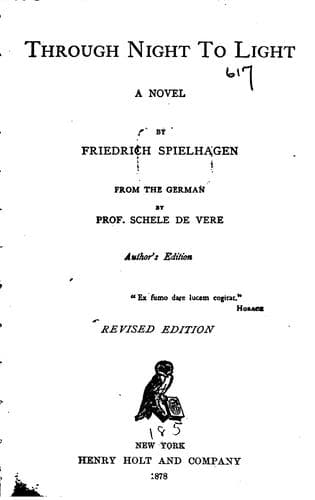
Through Night to Light: A NovelSpielhagen, Friedrich
General
Through Night to Light: A Novel
Spielhagen, Friedrich
Fiction
Partly to enjoy the comedy and partly for the sake of a "second
string," Albert Timm had met his old acquaintance from Grenwitz with
open arms, and had even carried the fun so far as to offer to become
his intimate friend. He calculated thus: It cannot be a bad speculation
in any case to be the friend of this disinherited knight. If the
Grenwitz keep their word and pay punctually--good; then it is a
beautiful evidence of your good heart, to let part of the abundance
drop into the lap of the knight who has unconsciously procured it for
you. If Anna Maria (he thought he was sure of Felix) wishes to break
the contract, or if an unforeseen accident relieves you of your
promise, still better; then your disinterested friendship for the
knight whose claims you then boldly advocate, gives you the strongest
claim upon his gratitude--in dollars.
Thus or nearly thus, the first sketch of his outline had been formed,
when Albert met Stein that night in the city cellar. Since that time he
had employed his leisure hours (and he had now an abundance) to fill up
the sketch, and he was so much pleased with his new plan, that he was
already considering whether it would not be better, after all, to
overthrow the legitimate ruling dynasty, and to proclaim Oswald as the
pretender. However, to act suddenly is not the manner of Indians, and
to throw away muddy water before you have clear water, is folly. Albert
found upon thoughtful reflection that Oswald was not quite ripe yet for
the part which he meant him to play. Oswald was an enthusiast, and
enthusiasts have all kinds of odd notions in their heads. For instance:
"Property is theft," or "the true beggars are the true kings," and so
forth. Might he not take up one of these odd notions at the very moment
when he ought to have acted promptly? It is true he found Oswald
greatly changed since he had seen him last. He seemed to have laid
aside his dreamy sentimentality, and to be filled with a concealed
restlessness, which broke forth now in extravagant merriment, and now
in savage, ironical bitterness. But who can ever judge rightly of
problematic characters? A remnant of the old ideology was no doubt
still there, and that had first to be driven out thoroughly. Faust,
just escaped from his cell, must find it impossible to return; he must
be taught to relish gay life; and how could he have found a better
teacher in this noble art than in the past grand master of all merry
fellows, the invincible Albert Timm, whose very sight was a laughing
protest against all old fogyism. And then there was a will-o'-the-wisp
with which the knight, wandering helplessly in the labyrinth of his
passions, could be led far into the morass, from where there was no
escape. This will-o'-the-wisp was love; his love for a certain great
and rich lady, for whose sake it was well worth while to leave the
straight road; a love which the knight had in the meantime confessed to
his friend, and which the friend fanned in a way which would have done
Public-domain text, read in full here on John Shaqi.
Reviews
Reviews
No reviews yet
Be the first to share your thoughts on this work.
Elsewhere in the archive
Join the Discussion
Join the discussion
Sign in to leave a comment or review.
Sign InorCreate an account