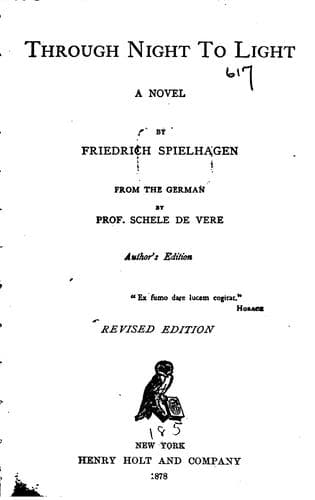
Through Night to Light: A NovelSpielhagen, Friedrich
General
Through Night to Light: A Novel
Spielhagen, Friedrich
Fiction
One would have thought Sophie cold and unfeeling, from hearing her
speak so calmly, almost coolly, of a plan which was decisive for her
and Franz's future, and which separated her, if carried out, perhaps
forever from her native town and her paternal home, from her friends
and acquaintances, and from a thousand familiar habits. And yet she
suffered unspeakably from the thought that she should have to leave her
father, whom she loved so dearly and who loved her so devotedly. But
she knew that he would adhere in the hour of decision to the principles
which he had inculcated in his daughter, and that he would expect the
same firmness from her. It was a hard struggle which these two noble
hearts had to endure the night after the evening on which Franz had
decided to leave Grunwald; a struggle such as every son of man has to
go through once or twice--and alas! in many cases again and again--in
his life; a struggle during which the perspiration runs in big drops
from the pain-furrowed brow, and the suffering heart prays: Father, if
it be possible, let this cup pass by me! But when on the next morning
father and daughter embraced each other without saying a word, and held
each other a long, long time, their eyes might gently overflow, but
their brows were clear and their hearts sang heavenly melodies.
From that moment Sophie gave her whole mind to the one great purpose to
arrange everything in the house so that her father might at least not
miss the accustomed comfort when she should leave him. Especially was
she anxious to find a person of her own sex who could fill her place at
table and in the evening, and assume the general direction of domestic
affairs. Her choice was soon made. The very day after that memorable
conversation before the fire-place, Bemperlein had, at Sophie's express
desire, brought Mademoiselle Marguerite to the privy councillor's
house. Sophie had been much pleased with the pretty, black-eyed French
woman, and congratulated Bemperlein sincerely on his selection. Then
already it had occurred to Sophie, that Marguerite might, after her own
marriage, manage her father's household. Now she hastened to carry out
this plan. The father, upon whom the "little Lacerta," as he called the
slim, slight figure, had made a very favorable impression, thought the
plan "not so bad;" Franz "approved," and as for Bemperlein, it was a
matter of course, that he adopted it with enthusiasm. He being the most
suitable person for the purpose, was therefore deputed to sound
Marguerite about her own views; and with such a fine diplomat as
Anastasius Bemperlein, it was not surprising that his most delicate
mission was crowned with the most brilliant success. Marguerite
declared that she was willing to accept the proffered honor _de tout
son coeur_, as soon as she was released from her present engagement.
Nothing, therefore, was now wanting but to obtain the gracious
dismissal of the Demoiselle Marguerite Martin from the position of
Public-domain text, read in full here on John Shaqi.
Reviews
Reviews
No reviews yet
Be the first to share your thoughts on this work.
Elsewhere in the archive
Join the Discussion
Join the discussion
Sign in to leave a comment or review.
Sign InorCreate an account