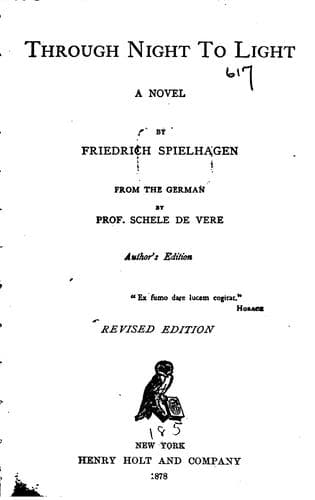
Through Night to Light: A NovelSpielhagen, Friedrich
General
Through Night to Light: A Novel
Spielhagen, Friedrich
Fiction
At the same moment, however, there was heard suppressed laughing in the
hall, where the servants seemed to be assembled. The door opened and a
strangely accoutred personage entered. Two huge goose-wings fastened to
the shoulders and a bow in the hand, with the requisite quiver and
arrows on the shoulder, together with a wreath on the head, proclaimed
him undoubtedly as Amor, although the spectacles on his nose hardly
agreed with the proverbial blindness of the god of love, nor the black
evening costume with the classic simplicity on which the Son of Venus
generally presents himself.
This strange figure approached the company with graceful steps,
remained standing at a respectful distance, bowed and spoke:
"Most highly honored, happy pair, most worthy father of the bride and
most darling demoiselle:
"I am--to see it is not hard--
The great god Amor.
Where'er my flames burn in a heart,
There I am, rich or poor.
Whoever hears my arrows rattle,
Forsakes the hope of doing battle;
The arrow sent from my good bow,
Strikes great and small and high and low.
And who is wounded by my hand,
Drops conquer'd on the sand.
I now will show you of my art,
A sample, which will make you start."
Here Amor took with great solemnity an arrow from his quiver, saying:
Do not fear, ladies and gentlemen, the string is loose, and the arrows
have, as you will please notice, huge India-rubber balls instead of
points. Thereupon he placed the harmless arrow on the harmless bow and
aimed it at Sophie, who caught it cleverly in her hand and pressed it
with comic pathos to her heart. The same proceeding was repeated with
Franz, except that it hit him on the head. After Amor had thus
demonstrated that he was not idly threatening, he continued,
"Now two have been dispatched,
And all their peace is gone;
It can be clearly seen
That they're forever done.
They know no rest and no repose,
If snow comes down, or blooms the rose,
Until the parson makes them one,
And they are altogether gone.
Then fare thee well, paternal home,
I must through all the world now roam!
Then fare thee well, oh father dear,
We never shall again be here!
Then fare ye well, oh friends of ours,
Who were our joy at all good hours!
Then fare ye well, good people all,
I have to follow another call!
To-morrow, with the evening star,
I shall be gone, oh ever so far!"
Public-domain text, read in full here on John Shaqi.
Reviews
Reviews
No reviews yet
Be the first to share your thoughts on this work.
Elsewhere in the archive
Join the Discussion
Join the discussion
Sign in to leave a comment or review.
Sign InorCreate an account