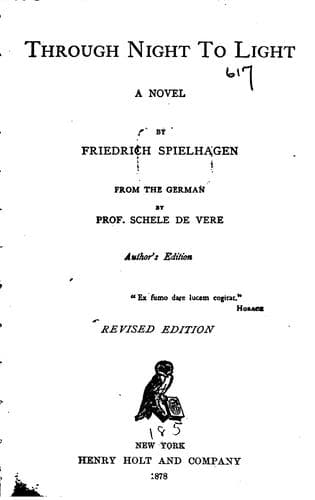
Through Night to Light: A NovelSpielhagen, Friedrich
General
Through Night to Light: A Novel
Spielhagen, Friedrich
Fiction
The music passed away; the lamps were extinguished. Quietly as they had
come the crowds went away. It was dark again in the street; but in the
hearts of those who were standing up-stairs in the bay-window, holding
each; other in close embrace, it was bright, like a sunny morning in
May.
CHAPTER VIII.
The great woods of Berkow are leafless. Where formerly birds were
singing in the green twilight, and beetles and midges humming drowsily
there the cold autumnal winds are now whistling through the bare
branches; and where dry leaves are yet hanging on old oak-trees, they
no longer whisper to each other lovingly as in the beautiful summer
time, but rustle weird and woefully. Only the evergreens look as if the
season could do them no harm; but their fine foliage also is darker,
and they look now, when all around is bare, blacker and more dismal
than ever.
Rough autumn has blown through the thick yew-hedge and into the garden
behind the castle, has swept the flowers from the whole parterre, and
filled the trim walks with withered wet leaves. On the terrace, under
the broad branching pine-tree, the favorite place of the mistress of
the house, the little round table with the marble slab is still
standing, because it is deeply rooted in the ground, but the green
benches and chairs have been carried into the garden-house.
The open place before the house, which is divided off by a railing from
the farm-buildings, looks melancholy. The shutters on this side of the
house are almost always closed, and are only now and then opened by a
wrinkled old hand, whereupon often, as just now for instance, the
wrinkled old face that belongs to the hand, with its icy gray
moustache, looks out for a few minutes to watch a wagon heavily laden
with wood, which four powerful horses can hardly drag through the deep
mud at the side entrance to the yard between two barns, where even in
summer the passage is often quite dangerous. The old man contracts his
brows angrily as he sees the servant whip the horses furiously, amid
calls and cries and curses. He grumbles something about 'infamous
fellow' in his gray beard; but he no longer raises his voice to give
vent to a powerful oath or so, as he used to do; for after all it is
not the servant's fault, but the tenant's, who has not been prevailed
upon these five years to mend the road. This tenant is every way a
vessel of wrath for the old man. He keeps his cattle in bad order; he
is cruel to his hands; in the third place he knows, according to the
old man's notions, nothing of farming; and, finally, he has a red nose,
and is always hoarse, two peculiarities attributed to brandy, and
equally disgusting to the old man's eyes and ears. And, above all, the
terrible prospect of never losing sight of this man for the whole of
his life (for his term has twenty years more to run, and the old man is
not going to live so long); to have to drag him along, so to say, till
Public-domain text, read in full here on John Shaqi.
Reviews
Reviews
No reviews yet
Be the first to share your thoughts on this work.
Elsewhere in the archive
Join the Discussion
Join the discussion
Sign in to leave a comment or review.
Sign InorCreate an account