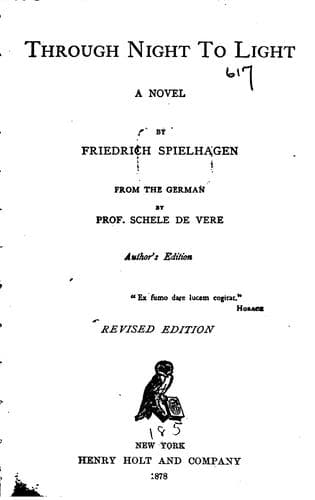
Through Night to Light: A NovelSpielhagen, Friedrich
General
Through Night to Light: A Novel
Spielhagen, Friedrich
Fiction
"And thus I have found more than one man in my life who was attached to
his wife with a love which was simply unbounded, which burnt with the
steady light of the north star, unchangeable, through the night of his
life. And certainly, when we find in history an Arnold Winkelried, who
defied death and made an opening for freedom with his body--did he do
it for freedom's sake? Yes! For his country's sake? Yes! But above all,
he did it for the sake of wife and children, who were to him more than
freedom and country and life itself."
Melitta let the book drop into her lap and looked thoughtfully down;
then she puts it again on the table, rises and takes an album from a
bureau, with which she sits down once more at the table. In the album
there are pencil sketches, and sketches in charcoal and sepia, of
landscapes and portraits, etc. She has not had the album in her hands
since last summer, and she has not taken it out now to draw or to
paint. She searches till she comes to a loose leaf, upon which the
profile of a man is lightly sketched in bold outlines. In the corner
are the letters A. V. O., and the date, July, 1844. The leaf has not
come loose of itself; it has evidently been torn out. What unnecessary
trouble we give ourselves by indulging in a moment's caprice! now the
detached leaf has to be carefully glued upon another! Well! it looks
quite well again; but alas! there the name and the date have been cut
off. What is to be done? name and date must be upon every sketch. The
young widow takes a pencil and writes: Adalbert von Oldenburg; the 22
November, 1847; then she closes the album, puts it back in the bureau,
and goes to the window.
It has become nearly dark, and instead of single flakes as before, the
snow is falling pretty thick; nor does it melt now on the ground, but
has already spread a thin, white cover over the lawn. Melitta begins to
be troubled about the long absence of Julius. Perhaps he has had after
all an accident; or perhaps it was the old man. She reproaches herself
for having allowed the boy to ride out so late; she is angry at
Baumann, that he at least has not been more prudent. And Oldenburg,
too, is not coming. If he were here she would ask him to ride out and
meet the two. How cheerfully he would do it!
Public-domain text, read in full here on John Shaqi.
Reviews
Reviews
No reviews yet
Be the first to share your thoughts on this work.
Elsewhere in the archive
Join the Discussion
Join the discussion
Sign in to leave a comment or review.
Sign InorCreate an account