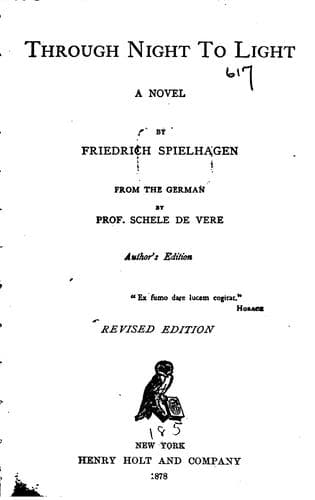
Through Night to Light: A NovelSpielhagen, Friedrich
General
Through Night to Light: A Novel
Spielhagen, Friedrich
Fiction
"'You can easily imagine what I felt when this occurred. Although the
search which I immediately ordered, and which was carried out with
great energy and circumspection, had no result, I was firmly convinced
that Berger had not attempted his life. He had too often spoken most
impressively against this way "of tying the Gordian knot still more
firmly," as he called it. A letter written by him, which I received
shortly afterwards, and which bore the post-mark of a small northern
town, proved to my great joy that I had not been mistaken. In this
letter the strange man asked my pardon if he should have caused me a
few disagreeable days by his stealthy departure from Fichtenau; he had
not known, he said, how else he could have carried out the idea which
he had mentioned to me. He had joined, for the moment, a party
consisting of "good people, but bad musicians," for the very purpose
of carrying out that idea, and the idea itself was this: that he
could not put his asceticism, the practical side of his theory of the
non-existence of life, to a satisfactory test within the four walls of
his room, or in solitude generally, but only in the wide world, and
especially amid the lower classes of society, to which he had now
descended for the purpose. He begged me, if I felt any interest in him,
not to interrupt him in his experiment, and promised to inform me at
the proper time of the result of his expedition, which promised to be
very favorable.'"
Oldenburg folded up Birkenhain's letter, after having read so far, and
looked at Melitta.
"How is it, Melitta?" he said; "you were several days in Fichtenau, I
know; did you also hear people talk of this beautiful gypsy woman and
her child, who must have been Xenobia and Czika, if I am not altogether
mistaken?"
"More than that," replied Melitta; "it was Xenobia and Czika, and I saw
them and spoke to them."
Oldenburg rested his head on his hand. "You did!" he murmured; "and
you--why did you not tell me?"
"Because I feared to renew your sorrow about the lost one;
because--listen to me, Adalbert, I will tell you. I would have told you
long ago if I had had the courage." And she told Oldenburg of her
meeting with the Brown Countess in the Fichtenau forest, how she had
tried to persuade the gypsy to come with her, and how she had been
grieved when she found all her persuasions and her prayers unavailing;
and, finally, how she had received from Xenobia the promise to bring
her the child if she should ever change her mind, and how she, Melitta,
was firmly convinced that this would happen sooner or later.
As the young widow told him all this, the tears were running down her
cheeks, and her voice trembled with deep emotion.
Public-domain text, read in full here on John Shaqi.
Reviews
Reviews
No reviews yet
Be the first to share your thoughts on this work.
Elsewhere in the archive
Join the Discussion
Join the discussion
Sign in to leave a comment or review.
Sign InorCreate an account