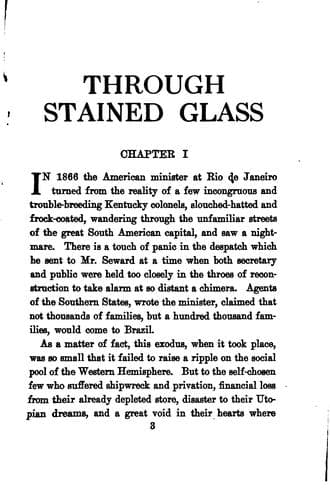
Through stained glass: A NovelChamberlain, George Agnew
General
Through stained glass: A Novel
Chamberlain, George Agnew
Fathers and sons -- Fiction; Love stories
"Nothing," said H lne, her thoughts wandering; "nothing that telling
will show you." She turned back to him and smiled. "Let's talk about
your pal Natalie. We're great friends."
"Friends?" said Lewis. "Have you been writing to her?"
"Oh, no," said H lne. "Women don't have to know each other to be
friends."
"Why, there's nothing more to tell about Natalie," said Lewis.
H lne looked him squarely in the eyes.
"Tell me honestly," she said; "haven't you wanted to go back to
Natalie?"
Lewis flushed. He rose and picked up his hat and stick.
"'You can give a new hat to a king, but it isn't everybody that will
take your cast-off clothes,' That's one of dad's, of course."
CHAPTER LII
Through that winter Lewis worked steadily forward to a goal that he knew
his father could not cavil at. He knew it instinctively. His grasp
steadied to expression with repression, or, as one of his envious, but
honest, competitors put it, genius had bowed to sanity.
It is usual to credit these rebirths in individual art to some great
grief, but no great grief had come to Lewis. His work fulfilled its
promise in just such measure as he had fulfilled himself. In as much as
he had matured, in so much had his art. Man is not ripened by a shock,
but by those elements that develop him to the point of feeling and
knowing the shock when it comes to him. In a drab world, drab would have
been Lewis's end; but, little as he realized it, his world had not been
drab.
Three steady, but varying, lights had shone upon him. The influence of
Natalie, as soft and still as reflected light; of H lne, worldly before
the world, but big of heart; and of Leighton, who had been judged in all
things that he might judge, had drawn Lewis up above his self-chosen
level, given sight to his eyes, and reduced Folly to the proportions of
a little final period to the paragraph of irresponsible youth.
To maturity Lewis had added a gravity that had come to him with the
realization that in distancing himself from youth he had also
unwittingly drawn away from the hearts that had done most toward
bringing him emancipation. He had no psychological turn of mind. He
could not penetrate the sudden reserve that had fallen upon his father
or the apparent increasing distraction with which H lne met his visits.
He did not know that it is in youth and in age that hearts attain their
closest contact and that the soul that finds itself, generally does so
in solitude.
He was hurt by the long silence of his father--a silence unbroken now in
months, and by H lne's withdrawal, which was marked enough to make him
prolong the intervals between his visits to her, and baffled him on
those rare occasions when they met.
Public-domain text, read in full here on John Shaqi.
Reviews
Reviews
No reviews yet
Be the first to share your thoughts on this work.
Elsewhere in the archive
Join the Discussion
Join the discussion
Sign in to leave a comment or review.
Sign InorCreate an account