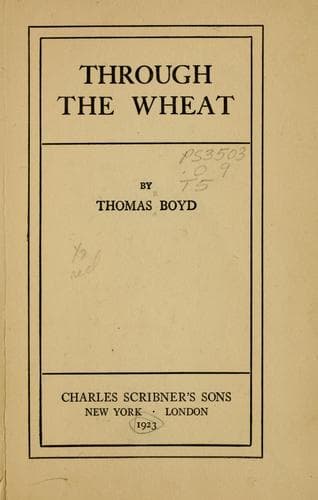
United States. Marine Corps -- Fiction; War stories; World War, 1914-1918 -- Fiction
In making the estimates of the divisions before him, the major-general
had only spoken aloud what the men secretly believed—that they were
the “finest flower of chivalry,” the epitome of all good soldierly
qualities. But to hear themselves so praised sounded unethical, made them
embarrassed. Had they been told that they were not shock troops, that
they were not the best soldiers in the known world, they would have been
indignant. Therefore they hid their gratitude and commendation under
a torrent of mordant remarks. The long lines were formed into squads,
demanding food, speculating upon the nearness of the attack, as they
marched back to their respective towns where they were billeted.
Hicks had not recovered from his despondency. His stomach felt as if he
had swallowed a stone every time reference was made to the attack. He had
done about enough in this war, he thought, wondering vaguely whether
there were no chance of escape. The thought of the sound of the guns
depressed him, their monotonous tom-tom beating in memory on his skull
like water dripping slowly on a stone. Disgusting! And no letters from
home, no change of scene, no clean clothing, nothing but the hopelessness
of routine, the bullying of petty officers, the prospect of the front.
He was still brooding when the platoon reached its billets in the town
to which it had come from the last drive. Instead of the unsavory food
steaming under a fire in the field kitchen, there was an issue of corned
beef, and slabs of black bread to be eaten. The field kitchens were
packed, the supply wagons were loaded. The persevering little mules that
hauled the machine-gun carts stood waiting. Orders were passed for the
men to pack up their equipment and be ready to fall into line on the
company street in half an hour. “Shake it up, you men,” the officers
called, walking back and forth past the buildings. “We haven’t got all
night.” Somebody asked where the platoon was going. “To the front,” an
officer answered. “Make it snappy.”
XIII
For two days now the bombardment had continued, heaving over the
live, huge shells that broke in the distance with a dull, sullen
fury. Lightly it had begun, and with an exchange of salutes from the
six-inch rifles. Then a number of batteries in the centre of the sector
started ferociously to bark. Along the left the heavy detonation of the
exploding shells was taken up, later to be joined by the smaller pieces
of artillery, which went off with mad, snapping sounds. The guns on the
right brought the entire line into action.
Public-domain text, read in full here on John Shaqi.
Reviews
Reviews
No reviews yet
Be the first to share your thoughts on this work.
Elsewhere in the archive
Join the Discussion
Join the discussion
Sign in to leave a comment or review.
Sign InorCreate an account