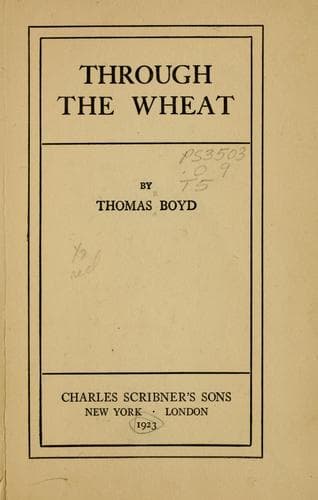
United States. Marine Corps -- Fiction; War stories; World War, 1914-1918 -- Fiction
The day brightened, and as he approached the trees they became separate
identities. The trees stared at him menacingly. They embarrassed him
by their scrutiny. He found himself making excuses for advancing toward
them. It was exasperating that no bullets were fired from the trees. He
wondered why it could be. And then he was at the woods, entering with the
rest of the men, and the underbrush parted with a crackling sound. He
drew back, frightened.
Because of the thickness of the underbrush and the irregularity of the
setting of the trees, he veered off to a path that led through the woods.
On it other men had made their way and were stealthily tramping through,
their eyes darting from one side to the other.
At a place where another path crossed, an ammunition wagon stood. The
bodies of four horses lay dead on the ground, their hides mutilated,
pierced by pieces of flying shell. The dead horses were a squeamish
sight, lying there with large reproachful eyes and slender necks that
seemed to have been broken. Their stomachs were inflated as if they had
eaten too much fresh clover. Hicks grew more depressed, his own stomach
wanted to describe a parabola inside of him. Hicks gagged, engaged in
a spasm of retching. The woods were covered with saffron, their trunks
were gaunt, and yellow splotches stuck out from the branches. The grass
wore a bilious complexion. He looked down at his shoes; they, too, were
yellow, unfamiliar, indefinable from the color of his puttees or his
mustard uniform.
He tramped on through the woods, hoping that his sickness would overpower
him, cast him to the ground where he could rest.
“If only I’d get so sick I couldn’t walk,” he thought, “how nice it would
be.”
He walked on, thinking of the spot in which he would like to lie, judging
with a discerning eye the softness and safety of various spots of ground.
The sight of a small hollow, with breastworks of fallen trees thrown up
on the dangerous side, was attractive to him. He was about to succumb,
but decided against it, thinking of the awkwardness of his position in
case some one should pass. And they were sure to pass, some snooping
lieutenant or orderly.
But he was supposed to be in an attack. Pugh and the rest were facing the
enemy at this very moment. And here he was lagging behind! Choking with
fright, he hurried out of the woods. The rest of the line had just broken
through the trees and now he joined them as they marched steadily ahead.
The field over which they were advancing stretched like a gridiron for
perhaps a mile, then it was lost in the thickly wooded hill that rose
majestically and invincibly. “God,” Hicks thought, “do we have to take
that hill?” It was inconceivable that it could be done, yet inconceivable
that it would not be done. There it rose—a Gethsemane—towering in the
air, austere and forbidding.
Public-domain text, read in full here on John Shaqi.
Reviews
Reviews
No reviews yet
Be the first to share your thoughts on this work.
Elsewhere in the archive
Join the Discussion
Join the discussion
Sign in to leave a comment or review.
Sign InorCreate an account