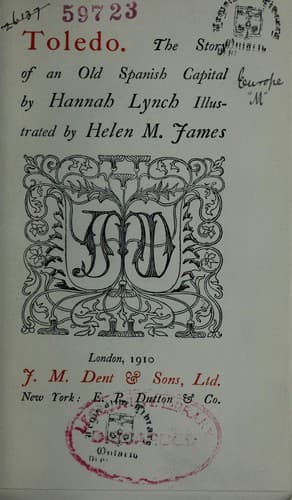
Toledo, the Story of an Old Spanish CapitalLynch, Hannah
History
Toledo, the Story of an Old Spanish Capital
Lynch, Hannah
Toledo (Spain) -- Description and travel; Toledo (Spain) -- History
Castillian genius has nowhere imprinted a haughtier effigy of its
invincible pride and fanaticism, insusceptible to the humiliations of
decay and defeat, impervious to the encroachments of progress and
enlightenment. It is the vast monumental note of Spanish character and
Spanish history. It tells the eternal tale of ecclesiastical domination
and triumph, and is the fitting home of portraits of warlike cardinals
and armoured bishops, of princes of the Church who wore the purple and
ruled with the sword. It is a superb and majestic harmony of marvellous
stone-work and painted glass.
The foundation of this most gorgeous temple is attributed to Saint
Eugenius, the first bishop of Toledo, and on the conversion of Recaredo
from Arianism, was dedicated to the Virgin Mary, April 12th, 587. When
the Moors took Toledo, the Cathedral was converted into a mosque, which
it remained for nearly three centuries. Then when Alfonso VI. won back
the town from the Moors, one of the conditions we know in the treaty for
surrender was that the Cathedral should continue as a mosque, and remain
in the hands of the conquered, upon which stipulation, solemnly
ratified, the Moors gave up the Alcázar, the city gates and bridges.
Alfonso intended that this condition should be fulfilled, but the queen
and the French archbishop, sorely troubled by the monstrous continuance
of heretical service in the consecrated temple of St Eugenius, decided
to cast out the Saracen, which injustice furnishes us with a pretty
evidence of Moorish magnanimity. Alfonso's was an exceedingly grim
interpretation of the chivalrous sentiment, "I could not love thee,
dear, so much, loved I not honour more." However, the Moors gallantly
tore up the treaty and resigned all right to the Cathedral. The least
they might have expected from their enemies is a full and fine
recognition of their generosity, first in pleading for those who had
insulted them, and then in foregoing their own advantage in order to
procure the pardon of their insulters. But no. The Moors, in this
matter, are regarded as having simply done their duty. One would
hesitate to credit their conquerors with a like behaviour in similar
circumstances. The Alfaqui's statue in the Capilla Major is regarded as
adequate thanks, and perhaps it is.
Public-domain text, read in full here on John Shaqi.
Reviews
Reviews
No reviews yet
Be the first to share your thoughts on this work.
Elsewhere in the archive
Join the Discussion
Join the discussion
Sign in to leave a comment or review.
Sign InorCreate an account