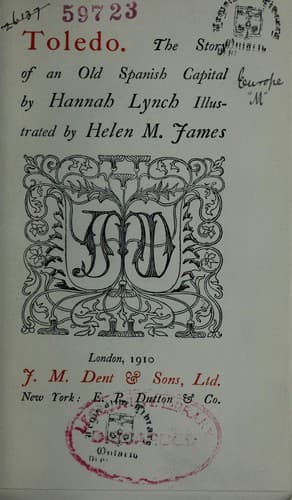
Toledo, the Story of an Old Spanish CapitalLynch, Hannah
History
Toledo, the Story of an Old Spanish Capital
Lynch, Hannah
Toledo (Spain) -- Description and travel; Toledo (Spain) -- History
Interest is attached to this church by the curious fact that not only
did El Greco build it, and build it so well with such cold and classical
correctness and simplicity, but here he lies at rest forever in his own
large temple. The precise spot of his grave is not known, and it is
quite an accident that such indication has been found. All the writers
have been content with the loose statement that he was buried either in
Santo Tomé or San Bartolomé, without a word of regret that he who
wrought such lasting monuments with his hand has found no reverent hand
to carve a slab above his dust. It was only quite lately that the
Spanish landscape painter, Señor de Berruete, to whose kindness I owe
the information and a copy of the registrar of the death, by sheer dint
of perseverance and conviction, brought to light the definite and
correct knowledge at last of El Greco's resting-place. He lies in some
obscure corner of this church, forgotten by the nuns on whose business
he first came to Toledo, and the record of his death and burial dryly
runs:--_Libro de entierros de Santo Tomé de 1601-1614, en siete del
Abril del 1614 falescio Dominico Greco. No hizo testamento, recibio los
sacramentos, enterose en Santo Domingo el Antiguo. Dio velas._
And that is all we know of his illness and death. He made no will, he
received the sacraments, he died on the 7th of April 1614, and left
tapers for his funeral. Under some stone of Santo Domingo he lies
forever ignored and unhonoured!
Many of the convents that possessed pictures of El Greco have
disappeared, amongst them the old convent of the Visitation called the
Queen's, which contained a superb Crucifixion. Of the figures at the
foot of the cross, Palomino wrote: "They are very Titian-like, and how
superior to anything else here!" We are told of a certain Magdalen, a
lovely bit of colouring, painted while the influence of the Venetian
school was still marked in his work, but this has become private
property. Some of his best pictures were painted for the little town of
Bayona near Cienpozuelos. The scenes from the dramatic life of Magdalen
were so beautiful that Cardinal Portocarrero offered 5000 pesos (about a
crown piece) and the same quantity of Giordanos to replace them to the
church, which were indignantly refused. In the College of Atocha and the
monastery of La Sisla there were considerable collections of some of the
best Grecos. Into whose hands have they since passed? and in how many
obscure parts of Spain may not these treasures lie hidden and
unrecognised? Palomino tells us of "an unapproachable Judgment." Alas!
nobody to-day knows anything about it.
Public-domain text, read in full here on John Shaqi.
Reviews
Reviews
No reviews yet
Be the first to share your thoughts on this work.
Elsewhere in the archive
Join the Discussion
Join the discussion
Sign in to leave a comment or review.
Sign InorCreate an account