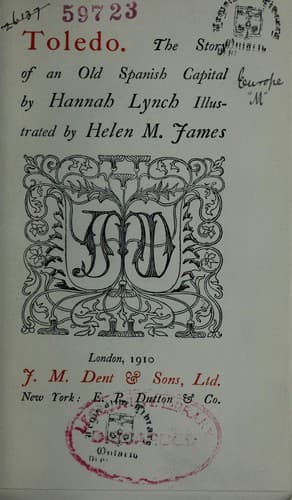
Toledo, the Story of an Old Spanish CapitalLynch, Hannah
History
Toledo, the Story of an Old Spanish Capital
Lynch, Hannah
Toledo (Spain) -- Description and travel; Toledo (Spain) -- History
traces about it, the highly decorated wall-work, the horse-shoe arches
and fine relief. Of the palace of the Trastarmares little now remains
but the door with the big Toledan nails. Somewhere about here was the
house Hernan Cortes was married from, when the bride's page stabbed
himself at her feet as the procession left the courtyard for the church.
I cannot indicate the precise spot, as I was shown it vaguely one lovely
moonlit night, when Toledo takes on its spectral and fantastic aspect of
white shadow-worked dream, a thing of elusive radiance, wherein reality
is lost in mysterious beauty. One walks knee-deep in the sadness and
enchantment of "old, unhappy, far-off things," and the petulant little
page, stabbing himself in the folds of the bride's white satin, as she
crosses the threshold of her father's house, is just the kind of picture
one is prompted to evoke. Alas, and alas! if we were only so fortunate
as to possess some clue by which we could hope to evoke the bride's
face, some faint perfumed trace of Toledan dame and damsel of those
days. But the Toledan school of painters has only left us an
interminable gallery of cavaliers, proud austere heads, with the mild,
cold and implacable regard of Spain. Of poetry, of womanhood, of soft
sensuous charm, not a hint. The exquisite Maria de Padilla, with her
little white visage and passionate, sad eyes, is only a name now; but
such was her gentle sorcery that she is still a dominating memory. We
cling to her the more as she is the single woman's form that floats
above this past of hard-featured and imperious knights, who ever jostled
and fought in these murderous streets and lanes, conspired, rebelled and
fashioned the roughest and strangest history written.
Near Santa Ursula is the façade of the famous house of the Toledos. The
founder of this great family, since known in history as the Dukes of
Alva, was a member of the Imperial house of Paleologus, Pedro, a
Byzantine prince of the days of Gothic rule. His immediate descendants
were the Illans; Stephen Illan, for whom was built the beautiful Casa de
Mesa, and whose portrait on horseback may be seen in the Cathedral,
behind the hideous _Trasparente_, was one of the greatest figures of
mediaeval Toledo, great citizen, unruly noble, defender of the town, and
lord of the people. It was after his day that the family was honoured
with the significant private name of Toledo, the present family name of
the house of Alva. The palace of the Toledos was like that of Villena,
an immense edifice covering all the square. Now only the façade remains
as a triumphal assertion of vanished splendour; a disfigured Gothic
porch and a couple of ajimez windows in the north wall in front of Santa
Ursula. Time has laid a heavy hand on the arches, the slim columns, the
cornices, the shields, the stone sculptures and friezes; but the Latin
inscription is still visible:
Public-domain text, read in full here on John Shaqi.
Reviews
Reviews
No reviews yet
Be the first to share your thoughts on this work.
Elsewhere in the archive
Join the Discussion
Join the discussion
Sign in to leave a comment or review.
Sign InorCreate an account