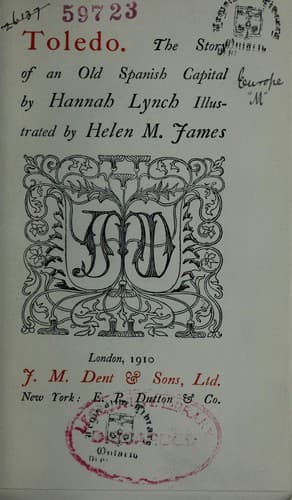
Toledo, the Story of an Old Spanish CapitalLynch, Hannah
History
Toledo, the Story of an Old Spanish Capital
Lynch, Hannah
Toledo (Spain) -- Description and travel; Toledo (Spain) -- History
Of the many hospitals of Toledo, two alone are famous, one what the
Spanish guides very properly call "a sumptuous work of art." Descending
the steps through the Moorish archway of the Zocodover, you leave
Cervantes' inn on the right, and a little lower down on the left is the
Hospital of Santa Cruz, the hospital of Mendoza, "The Cardinal of
Spain," now incongruously enough a school of infantry. The traveller,
enamoured of the picturesque, in awed surrender to the charm of noble
ruins, grows to loathe the military all over Europe. They take up their
quarters so profanely in monuments one hardly dares to lift one's voice
in. They sprawl in their motley uniforms over the loveliest homes of
romance and memories, and burthen the silence with their futile
miseries, labours, and tyrannies. In times of war the army makes a
gallant figure. Then each man is a hero, and we willingly tend his
wounds. But in times of
[Illustration: DOOR OF SANTA CRUZ]
peace the soldier is frankly an anachronism and a nuisance. He
desecrates ruins and spoils the view; he vulgarises the atmosphere of
legend, and cheapens the majesty of dismantled walls. There is, of
course, no reason but a sentimental one why the sabred heroes of Spain
should not sleep within the walls of a magnificent monument, and
exercise their muscles in the lovely chapel of Mendoza, now their
gymnasium, but what will you?--a traveller is necessarily sentimental.
The great cardinal of Spain designed to build an hospital for
foundlings, and had engaged the architect, Enrique Egas, and with him
traced the plan, when death overtook him at Guadalajara in 1495, and he
bequeathed his idea, with over 75,000 ducats for its completion, to
Queen Isabel and his relative the Duke of Infantado. The Queen chose the
spot on account of the wide view of the hills rolling upward from the
opposite river banks, and the hospital was called Santa Cruz because of
the founder's devotion to the Holy Cross. It was originally a royal
Gothic palace, converted later into a Moorish palace, it is said, the
town residence of Galiana's father, Galafré. Possibly here may have
dwelt Casilda, the King's daughter, who from her earliest years, loved
the Christians and pitied them, and carried food to the Christian
prisoners. She vowed to devote herself to the poor and live a maid, to
King Almenor's dismay, who proposed one after another brilliant match to
her in vain. Standing at the palace gate one day he found her carrying a
basket of provisions to the prisoners, and asked her what the basket
contained. "Roses," said Casilda like St Elisabeth of Hungary, and
opening the basket, to her surprise discovered it full of red and white
roses. There, too, may have taken place that strange bridal of Doña
Theresa, sister of the King of Leon and the Moorish king Abdallah, when,
it is said, an angel interposed to prevent the union of Christian
princess and Moorish monarch, and the King thus convinced of the
Public-domain text, read in full here on John Shaqi.
Reviews
Reviews
No reviews yet
Be the first to share your thoughts on this work.
Elsewhere in the archive
Join the Discussion
Join the discussion
Sign in to leave a comment or review.
Sign InorCreate an account