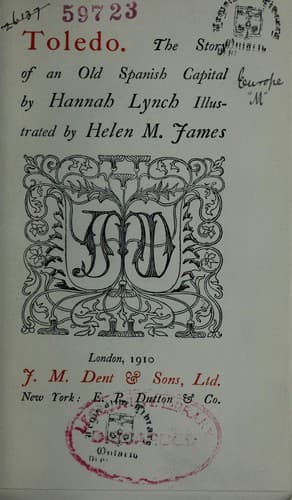
Toledo, the Story of an Old Spanish CapitalLynch, Hannah
History
Toledo, the Story of an Old Spanish Capital
Lynch, Hannah
Toledo (Spain) -- Description and travel; Toledo (Spain) -- History
[2] A document exists purporting to be the original letter sent by the
Jews of Toledo to their co-religionists of Jerusalem at the time of
the Crucifixion. It is addressed: _Levi archisinagogo é Samuel Joseph,
omes bonos de la aljama de Toledo à Eleazar mint gran sacerdote é à
Samuel Ecaniet, Annas y Caiphas, omes bones de la aljama de la terra
sancta, salud en el Dios de Israel_. It is signed: De Toledo à XIV.
dais del mes de Nizan era del César XVIII. y de Augusto Octaviano LXX.
But the "omes bonos" of the Holy Land had settled the question before
the lengthy epistle of the "good men" of Toledo reached them.
[3] Conde de Mora: "Historia de Toledo."
[4] "Bib. Nat.," p. 16, v. 21
[5] It was chiefly in other Gothic towns that Wamba's fortifications
were demolished. Toledo comparatively escaped.
[6] My notes from the Chronicle says _a hundred thousand workshops_,
but this in revision seems a slip of the pen. Such a number of
workshops even at so flourishing an hour would have encumbered Toledo
very seriously, I imagine.
[7] Dozy regards Count Julian as an authentic historical figure though
both his rank and authority are undefined. He believes he was neither
a vassal nor a Spanish subject, and consequently no traitor. But was
he a Berber, a Greek, an independent prince or tributary of Spain or
of the Emperor of Constantinople? Dozy suggests he may have been an
Arabian governor of Ceuta, under the Byzantine emperor, while Arabian
authors describe him as a mere merchant.
[8] Mr Stanley Lane Poole in his "Moors in Spain" (wherein he accepts
the old-fashioned but improbable legend of Julian or Florinda as
history) suggests that Rodrigo was drowned and washed out by the great
ocean, and describes the last of the Goths as a kind of legendary
Arthur, enfolded in mystery and awaited by his mourning subjects like
the Irish Knights who in mediæval times were expected to return from
some dim region of rest to take up again the burden of our life, and
lead their followers to victory and prosperity.
[9] Rasis el Moro, Spain, MS. Bib. Pro.--Toledo.
[10] Abou-l-Hasan: Dozy, _Recherches sur l'histoire et la littérature
d'Espagna_.
[11] "Histoire de Philippe II." by H. Fornaron.
[12] The Archbishop of Zamora, Antonio de Acuña, a fierce _comunero_,
commanded in the absence of Padilla, and was mighty profane in his
method of war for an archbishop. After leading his troops against the
King's Castle of Aguila, he resolutely stormed the Cathedral gates and
maltreated the resident canons. The insurgents held the cloisters and
prevented the celebration of any church office during their stay. The
unfortunate chapter was kept for three entire days and nights from
sleeping or eating. What an incredible scandal in hieratic Toledo!
Public-domain text, read in full here on John Shaqi.
Reviews
Reviews
No reviews yet
Be the first to share your thoughts on this work.
Elsewhere in the archive
Join the Discussion
Join the discussion
Sign in to leave a comment or review.
Sign InorCreate an account