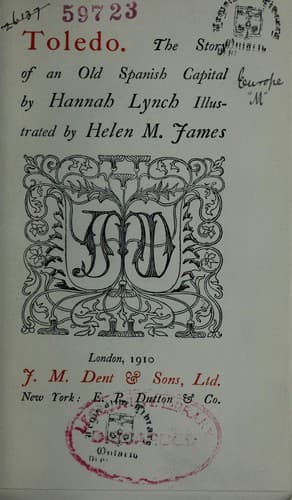
Toledo, the Story of an Old Spanish CapitalLynch, Hannah
History
Toledo, the Story of an Old Spanish Capital
Lynch, Hannah
Toledo (Spain) -- Description and travel; Toledo (Spain) -- History
Entering the city by the striking bridge of San Martin, you pass the
picturesque ruin of the _Baño de la Cava_, where the too charming
Florinda is supposed to have bathed for the doom of Don Rodrigo and the
ruin of Gothic Spain. Rodrigo's castle, of which not a trace now
remains, was built on the high rock above, and indiscreet eyeshot sent
down upon this sacred spot is said to have revealed to him a seductive
vision of a beautiful bare limb. The ruin is probably that of a towered
bridge, suggested by the big grey stone on the opposite bank. The spot
is, however, romantic enough for any legend, and those who prefer
tradition to fact will say, if Florinda did not bathe there, she ought
to have done so. The view on this side is more beautiful than even on
the other. A Spanish friend, whose privilege it is to paint Toledo in
all her wild and sad enchantment, in a big house above the Puerta del
Cambron, overlooking the wavy water-line from the bridge of San Martin
and the exquisite diversity of orchard and meadow-land, has offered me
many delightful moments of contemplation of this unique view from his
broad terrace. It combines in the rarest form a light and smiling charm
with a superb and matchless melancholy. From this point of entrance you
twist up and down through the most mysterious streets of the world. Who
designed them, who fashioned them? How came any town to be so built?
Streets so narrow that hand may touch hand from either side, and soft
converse be held through opposite windows; so rounded that an enemy
advancing might fall upon you unperceived. How many lovely façades,
alas! eaten away, a sullen magnificent protest against modern times,
with divine arches showing here and there through miserable plaster!
Everywhere Moorish faience, and curious Toledan doors in Arabian or
Gothic porches, for all the world like the doors of palaces in
fairyland, ornamented with huge carved iron nails. And when the doors
stand open, glimpses of bright clean patios, with their gleaming bands
of _azulejos_, their centre well and little stunted trees. All so dull,
so still, so silent. Now and then you may chance to meet a woman
following a mule laden with fruit and vegetable, which she sells from
house to house, or a water-carrier, or an itinerant pedlar shouting the
value and nature of his wares up to the balconies. Some of the street
effects of grouping and colouring are of an indescribable witchery.
Where will you match such a corner as that of the old palace of the
Cardinal D. Pascual de Aragon, now a convent? Words are useless to
convey an idea of its quaintness, the effect of pink and green, of iron
balcony, of wrought stone, of broken façade and charming variety of
line. These are things that even a painter can hardly hope to reproduce.
And such corners abound in Toledo. The foot treads the very pavement of
romance and legend, where everything is a gratification for the eye, and
the dream of the mourner of departed centuries is remorselessly
Public-domain text, read in full here on John Shaqi.
Reviews
Reviews
No reviews yet
Be the first to share your thoughts on this work.
Elsewhere in the archive
Join the Discussion
Join the discussion
Sign in to leave a comment or review.
Sign InorCreate an account