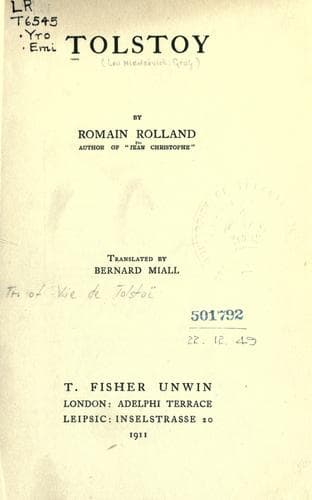
Tolstoy, who wished to found an art for all men, achieved universality
at the first stroke. Throughout the world his work has met with a
success which can never fail, for it is purged of all the perishable
elements of art, and nothing is left but the eternal.
_The Power of Darkness_ does not rise to this august simplicity of
heart: it does not pretend to do so. It is the reverse side of the
picture. On the one hand is the dream of divine love; on the other, the
ghastly reality. We may judge, in reading this play, whether Tolstoy's
faith and his love of the people ever caused him to idealise the people
or betray the truth.
Tolstoy, so awkward in most of his dramatic essays,[13] has here
attained to mastery. The characters and the action, are handled
with ease; the coxcomb Nikita, the sensual, headstrong passion of
Anissia, the cynical good-humour of the old woman, Matrena, who gloats
maternally over the adultery of her son, and the sanctity of the old
stammering Hakim--God inhabiting a ridiculous body. Then comes the fall
of Nikita, weak and without real evil, but fettered by his sin; falling
to the depths of crime in spite of his efforts to check himself on the
dreadful declivity; but his mother and his wife drag him downward....
"The peasants aren't worth much.... But the _babas!_ The women! They
are wild animals ... they are afraid of nothing! ... Sisters, there
are millions of you, all Russians, and you are all as blind as moles.
You know nothing, you know nothing!... The moujik at least may manage
to learn something--in the drink-shop, or who knows where?--in prison,
or in the barracks; but the _baba_--what can she know? She has seen
nothing, heard nothing. As she has grown up, so she will die.... They
are like little blind puppies who go running here and there and ramming
their heads against all sorts of filth.... They only know their silly
songs: 'Ho--o--o! Ho--o--o!' What does it mean? Ho--o--o?
They don't know!"[14]
Then comes the terrible scene of the murder of the new-born child.
Nikita does not want to kill it. Anissia, who has murdered her husband
for him, and whose nerves have ever since been tortured by her crime,
becomes ferocious, maddened, and threatens to give him up. She cries:
"At least I shan't be alone any longer! He'll be a murderer too 1 Let
him know what it's like!" Nikita crushes the child between two boards.
In the midst of his crime he flies, terrified; he threatens to kill
Anissia and his mother; he sobs, he prays:--
"Little mother, I can't go on!" He thinks he hears the mangled baby
crying.
"Where shall I go to be safe?"
It is Shakespearean. Less violent, but still more poignant, is the
dialogue of the little girl and the old servant-woman, who, alone
in the house, at night, hear and guess at the crime which is being
enacted off the stage.
Public-domain text, read in full here on John Shaqi.
Reviews
Reviews
No reviews yet
Be the first to share your thoughts on this work.
Elsewhere in the archive
Join the Discussion
Join the discussion
Sign in to leave a comment or review.
Sign InorCreate an account