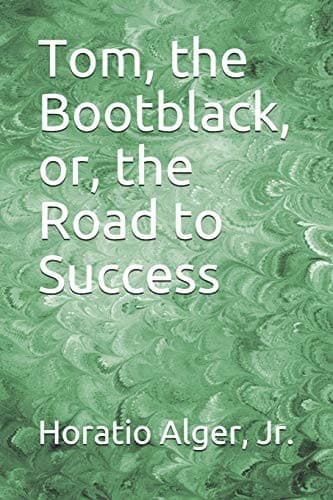
Tom, The Bootblack; or, The Road to SuccessAlger, Horatio, Jr.
General
Tom, The Bootblack; or, The Road to Success
Alger, Horatio, Jr.
Adventure and adventurers -- Juvenile fiction; Boys -- Juvenile fiction; Conduct of life -- Juvenile fiction
"But ye dinna understand," said the bewildered Davie. "I ha'e na been
gude. I e'en had it in my heart to be a thief, a wicked, pawkie thief."
"What you _intended_ to do matters less to me than what you have really
done," answered the good-natured laird.
"Are ye na going to put me in prison, or turn me out o' my place?"
"On the contrary, I am going to reward you for the service you have
rendered."
"That maun na be," cried Davie, drawing back. "Dinna ask me. I seek na
reward but to feel that I can once mair look my fellow-creatures in the
face, _an honest man_. An' the story o' what I ha'e suffered shall aye
be a warning to me, and to my bairns after me, _to flee frae
temptation_."
A happy circle was that which gathered round Davie's ingle that night,
the ingle from which the ale-house never again had power to allure him.
Jean, the gudewife, with her sewing in her hand, and the old gray cat
at her feet, shall be the central figure. Grandmother sits on one side
of the fireplace, spinning flax--ever and anon bursting out into some
old Jacobite song--and Davie himself in the arm-chair, on the other
side, with Jamie on his knee. On a low seat close by him is Nannie--now
looking into her father's face, and now glancing beyond--for there sits
Robbie Ainslee.
And so we drop the curtain.
LLOYD'S FIRE ON THE BEACH.
Lloyd and Jem were squatted up among the rocks, watching a vessel out
to sea.
It was a cold evening,--Christmas eve,--the night coming on fast. No
vessel had any business to be out there among the breakers, running in
straight on the bar; that is, if any man aboard of her knew what he was
about.
So Lloyd and Jem said, at least, and they had a right to know, as they
had been born and bred on that bit of rocky island, and knew every foot
of the sea within a mile, as well as they knew their own crab-boats and
drag-nets.
The vessel was a small schooner, such as ran down to the island from
town in summer with flour, and took back crabs and fish.
"But what can she want now?" said Jem.
"She don't know the coast," said Lloyd. "She'll be on the rocks in an
hour, if she don't tack."
Jem went to school over on the mainland in winter. There was no need
for him to work so hard, either. The money he made by gunning or
fishing he spent for tops and kites. But Lloyd's mother, Mrs. Wells,
who lived in a little brown cottage back of the rocks, was not able to
keep him and herself without his help. For two or three years he had
worked as hard as any man on the island. There had been another son of
Mrs. Wells, older than Lloyd, a young man called John. But he had been
mate on the _Swallow_, that was wrecked on the Irish coast four years
ago, when all the crew were lost--never heard of again.
So there was nobody left but Lloyd. In winter, when there was no
fishing, he whittled crosses and paper-knives out of the cedars,
trimming them with lichen, and sent them over to town for sale.
Public-domain text, read in full here on John Shaqi.
Reviews
Reviews
No reviews yet
Be the first to share your thoughts on this work.
Elsewhere in the archive
Join the Discussion
Join the discussion
Sign in to leave a comment or review.
Sign InorCreate an account