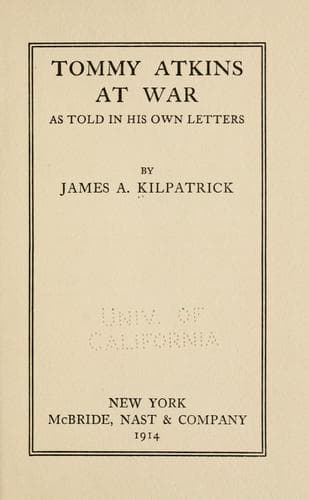
Tommy Atkins at War: As Told in His Own LettersKilpatrick, James Alexander
History
Tommy Atkins at War: As Told in His Own Letters
Kilpatrick, James Alexander
Great Britain. Army -- Military life; World War, 1914-1918
"Fired at constantly both by friend and foe," Sir John French writes,
"and not hesitating to fly in every kind of weather, they have remained
undaunted throughout." The highest praise is bestowed upon
Brigadier-General Sir David Henderson, in command of the Corps, for the
high state of efficiency this young branch of the service has attained.
It has been on its trial, and has already covered itself with glory.
General Joffre, the French Commander-in-Chief, has sent a special
message singling out the British Flying Corps "most particularly" for
his highest eulogies. Several English airmen have already been made
Chevaliers of the Legion of Honor.
That the nervous strain of aerial warfare is severe is shown by
expression in several airmen's letters. Not only have they to fight
their man, but they have to manage their machines at the same time. This
means that if an airman ascends alone he is unable to use a rifle and
must depend for attack on revolver fire only. This is illustrated by a
passage in one of the official reports: "Unfortunately one of our
aviators, who has been particularly active in annoying the enemy by
dropping bombs, was wounded in a duel in the air. Being alone on a
single-seated monoplane, he was not able to use a rifle, and whilst
circling above a German two-seater in an endeavor to get within pistol
shot was hit by the observer of the latter, who was armed with a rifle.
He managed to fly back over our lines, and by great good luck descended
close to a motor ambulance, which at once conveyed him to hospital."
This appears to be only the second instance recorded during the first
two months of the war in which our airmen have suffered mishap, yet
half-a-dozen German machines have been brought down and their navigators
either killed or wounded. Private Harman, King's Royal Rifles, describes
an exciting pursuit in which a German aeroplane was captured. The
British aviator, who had the advantage in speed and was a good revolver
shot, evidently greatly distressed the fugitive, for, surrendered, he
planed down in good order, and on landing was found to be dead.
Public-domain text, read in full here on John Shaqi.
Reviews
Reviews
No reviews yet
Be the first to share your thoughts on this work.
Join the Discussion
Join the discussion
Sign in to leave a comment or review.
Sign InorCreate an account