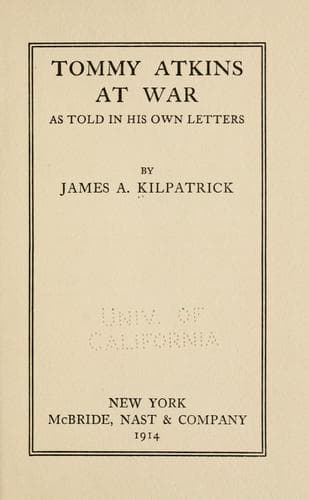
Tommy Atkins at War: As Told in His Own LettersKilpatrick, James Alexander
History
Tommy Atkins at War: As Told in His Own Letters
Kilpatrick, James Alexander
Great Britain. Army -- Military life; World War, 1914-1918
According to an officer in the Royal Flying Corps the worst aerial
experience in war is to go up as a passenger. "It is 'loathly,'" he
says, "to sit still helplessly and be fired at." In one flight as a
spectator his machine was "shelled and shot at about a hundred times,
but luckily only thirteen shots went through the planes and neither of
us was hit." An interesting account of a battle seen from the clouds is
given in a letter published by _The Times_. "I was up with ---- for an
evening reconnaissance over this huge battle. I bet it will ever be
remembered as the biggest in history. It extends from Compiegne right
away east to Belfort. Can you imagine such a sight? We flew at 5 p.m.
over the line, and at that time the British Army guns (artillery, heavy
and field) all opened fire together. We flew at 5,000 feet and saw a
sight which I hope it will never be my lot to see again. The woods and
hills were literally cut to ribbons all along the south of Laon. It was
marvelous watching hundreds of shells bursting below one to right and
left for miles, and then to see the Germans replying."
Another officer of the Flying Corps describes his impression of the
Battle of Mons, seen from a height of 5,000 feet. British shells were
bursting like little bits of cotton wool over the German batteries. A
German attack developed, and the airman likens the enemy's advance
formation to a "large human tadpole"--a long dense column with the head
spread out in front.
Evidently the anti-aircraft guns, though rather terrifying, do very
little damage. Airmen have had shells burst all round them for a long
time without being hurt. Of course they are careful to fly at a high
altitude. When struck by shrapnel, however, an aeroplane (one witness
says) "just crumples up like a broken egg." On the other hand, bombs
dropped from aeroplanes do great damage, if properly directed. A petrol
bomb was dropped by an English airman at night into a German bivouac
with alarming results, and another thrown at a cavalry column struck an
ammunition wagon and killed fifteen men. A French airman wiped out a
cavalry troop with a bomb, and the effect of the steel arrows used by
French aviators is known to be damaging. The German bombs thrown by
Zeppelins and Taube aeroplanes on Antwerp and Paris do not appear to
have much disturbed either the property or equanimity of the
inhabitants. So far as aerial excursions are concerned the most
brilliant exploit is undoubtedly that of Flight-Lieutenant C.H. Collet,
of the Naval Wing of the British Flying Corps, who, with a fleet of five
aeroplanes swept across the German frontier and, hovering over
Duesseldorf, dropped three bombs with unerring effect upon the Zeppelin
sheds.
Public-domain text, read in full here on John Shaqi.
Reviews
Reviews
No reviews yet
Be the first to share your thoughts on this work.
Join the Discussion
Join the discussion
Sign in to leave a comment or review.
Sign InorCreate an account