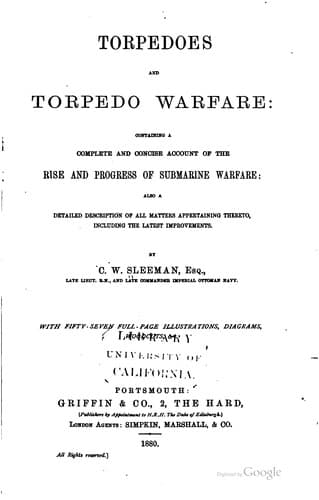
Torpedoes and Torpedo Warfare: Containing a Complete and Concise Account of the Rise and Progress of Submarine WarfareSleeman, Charles William
History
Torpedoes and Torpedo Warfare: Containing a Complete and Concise Account of the Rise and Progress of Submarine Warfare
Sleeman, Charles William
Torpedoes
One of the causes which led to the failure of offensive submarine
weapons, when employed on active service, seems to be due to the fact
that, owing to the extremely small radius of the destructive effect
of such weapons, it is absolutely necessary for complete success to
explode the mine in actual contact with the attacked vessel; to ensure
which, at night time, in an unknown harbour, with the position of the
vessel attacked somewhat uncertain, and even without the additional
obstacles of guard boats, booms, electric lights, &c., is a service of
infinite difficulty, and one which may easily terminate in a failure.
The foregoing would more especially apply to the spar torpedo attack,
but in an attack with the Whitehead fish, or towing torpedo, there
would be an additional cause of failure, viz., the complicated nature
of their manipulation.
Torpedoes may be divided into four classes, viz.:--
1.--Drifting or floating torpedoes.
2.--Towing torpedoes.
3.--Locomotive torpedoes.
4.--Outrigger or spar torpedoes.
_Drifting or Floating Torpedoes._--By "drifting" or "floating"
torpedoes are meant all those submarine machines which are dependent on
the tide or current of a stream for their action and motion.
During the American civil war this mode of attacking vessels was
constantly employed by the Confederates, and though not successful in
destroying any of the Federal ships, was the means of considerably
hampering the movements of their river flotillas.
Drifting torpedoes might be advantageously used for the destruction of
pontoon bridges, booms, &c., and in this way, had the Turks in their
late war used them, the Russians would have found the crossing of
the Danube a matter of infinite danger and difficulty; in fact, by
a systematic use of such weapons, combined with a little dash on the
part of the Ottoman flotilla on the Danube, that river should have been
to the Russians an impassable barrier. To use these torpedoes most
effectively, especially against a single vessel, a thorough knowledge
of the force and direction of currents should be gained before
proceeding to undertake an operation in which these submarine weapons
are used.
Another point to be remembered is, that if such a torpedo were started
with the flood, for example, towards an enemy, and did not explode,
there would be a chance of its being returned to the starting-place by
the ebb tide.
In this class the following torpedoes seem the most practicable:--
1.--Lewis's drifting torpedo.
2.--McEvoy's drifting torpedo.
3.--American extempore drifting torpedo.
Public-domain text, read in full here on John Shaqi.
Reviews
Reviews
No reviews yet
Be the first to share your thoughts on this work.
Elsewhere in the archive
Join the Discussion
Join the discussion
Sign in to leave a comment or review.
Sign InorCreate an account