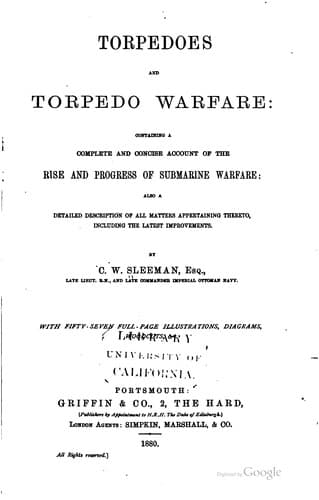
Torpedoes and Torpedo Warfare: Containing a Complete and Concise Account of the Rise and Progress of Submarine WarfareSleeman, Charles William
History
Torpedoes and Torpedo Warfare: Containing a Complete and Concise Account of the Rise and Progress of Submarine Warfare
Sleeman, Charles William
Torpedoes
"The vessel is constructed with five water-tight bulkheads, and her
hull is of composite construction below the water line, having a
steel framing covered with wood planking. The upper part of the hull
is wholly of steel, the plates being 1/16 inch thick, the top sides
sloping inwards and the upper work forming a protective superstructure
for the crew and machinery. She is propelled by a screw which is placed
beneath the vessel in a central position, and which is driven by a
direct acting condensing engine placed in the forward part of the boat.
The diameters of the steam cylinders are 10-1/2 inches and 6 inches
respectively, with 10 inch stroke, and they are of 100 horse power
estimated. There is an independent feed pump and air pump. The stoke
hold is enclosed and is supplied with air by a Sturtevant blower, which
is driven by an independent engine of 2-1/2 horse power. The propeller
is a two-bladed screw 38 inches in diameter and 5 feet pitch, the
screw shaft being 23 feet in length. The vessel is steered by means
of a balanced rudder placed a short distance from the stern and under
the ship, the helmsman being located in a stern cabin with a protected
look-out raised just above the deck. The hull and machinery together
weigh 6 tons, but with the working crew of four men and fuel, stores,
and two torpedoes on board, boat weighs about 7-1/2 tons.
"Steam is supplied by a Herreshoff coil boiler, which constitutes
another novelty in this boat. This boiler consists of a circular
combustion chamber, which in the present instance is 4 feet in diameter
internally, and within which is a coil of about 300 feet of 2 inch pipe
coiled to nearly the diameter of the chamber. This coil is continued at
the top so as to form a kind of dome under the cover of the combustion
chamber. By the side of the boiler is a separator, into which the
steam passes before it goes to the engine. The water from the feed
pump is admitted at the top of the coil, and during its course to the
bottom the greater portion of it becomes converted into steam. Having
passed through the entire length of the coil, the steam and water are
discharged together into the separator in such a manner that the water
is entirely separated from the steam, and can be blown off as required.
The steam is taken from the top of the separator, and returns through
a short coil placed inside the combustion chamber, where it becomes
superheated, and is led thence to the engines. It is claimed for this
boiler that it cannot explode destructively, inasmuch as there is
but a very small quantity of water in it at any time, and that it is
distributed along the entire length of the coil. A rupture at any point
would only be attended by a moderate blowing off of steam. The rapid
circulation of the water is found to prevent the deposit of salts, the
surplus water not converted into steam carrying with it all impurities.
A good working pressure can be obtained within a few minutes of
Public-domain text, read in full here on John Shaqi.
Reviews
Reviews
No reviews yet
Be the first to share your thoughts on this work.
Elsewhere in the archive
Join the Discussion
Join the discussion
Sign in to leave a comment or review.
Sign InorCreate an account