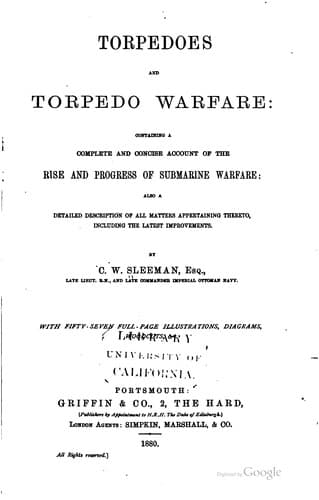
Torpedoes and Torpedo Warfare: Containing a Complete and Concise Account of the Rise and Progress of Submarine WarfareSleeman, Charles William
History
Torpedoes and Torpedo Warfare: Containing a Complete and Concise Account of the Rise and Progress of Submarine Warfare
Sleeman, Charles William
Torpedoes
No new torpedo invention should be adopted, however theoretically
perfect it may be, until it has been subjected to a very severe
practical test, under conditions as nearly analogous to those that
would occur on active service as it would be possible to obtain. The
vast importance of a carefully planned and executed system of submarine
_defence_ is an established fact, and it only remains to discover what
are the best weapons for, and most practicable mode of manipulating a
system of submarine offence, to establish torpedo warfare in all its
branches as a necessary function of naval warfare.
It would be a mere waste of time to dwell on the Anglo-French and
American wars of the beginning of this century (1797-1812); though
during that period various attempts were made by Fulton and others
to destroy hostile vessels by means of submarine infernal machines,
inasmuch as they all partook more or less of the nature of experiments,
and were all failures, but come at once to the Crimean war (1854-1856),
when what may be termed a systematic employment of torpedoes for
harbour defence was first employed.
CRIMEAN WAR (1854-56).
_Defence of Sebastopol Harbour, &c._--The Russians employed a large
quantity of submarine mines, both electrical and mechanical,
principally the latter, in their defence of the harbours of Sebastopol,
Sveaborg, and Cronstadt.
According to General Delafield, U.S.A., the arrangement of the
mechanical mines was entirely new, the conception and idea of an
eminent Russian chemist, Professor Jacobi.
_Electrical Mines._--No mention is made by the General of the
employment of electrical mines, but the fact of a hulk being captured
by the Allies at Yenikale, with a number of torpedoes on board, and
all the arrangements necessary to explode them by electricity, such as
Voltaic piles, electric fuzes, several miles of conducting wire, &c.,
is sufficient proof of this type of submarine mine being extensively
used by the Russians in their harbour defences.
Many of their mechanical mines were picked up by the Allies, several of
which were found to have their safety caps on. Owing to this neglect,
and the smallness of the charge of the torpedoes (only some 25 lbs. of
gunpowder), it is not to be wondered at that no serious injury was done
to any ships of the allied squadron.
Deterred most probably by the failures of Bushnell, Fulton, and others
in previous years with the submarine and other torpedo boat attacks,
nothing of this description was attempted by either side.
_Russian Mechanical Mines._--The Russian mechanical mines consisted
of barrels of powder fitted with fuzes, so arranged that a blow would
smash a glass tube containing sulphuric acid, causing the acid to mix
with some chlorate of potash, resulting in combustion and the explosion
of the mine.
AUSTRO-ITALIAN WAR (1859).
Public-domain text, read in full here on John Shaqi.
Reviews
Reviews
No reviews yet
Be the first to share your thoughts on this work.
Elsewhere in the archive
Join the Discussion
Join the discussion
Sign in to leave a comment or review.
Sign InorCreate an account