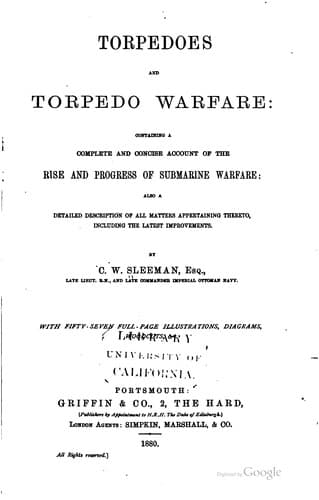
Torpedoes and Torpedo Warfare: Containing a Complete and Concise Account of the Rise and Progress of Submarine WarfareSleeman, Charles William
History
Torpedoes and Torpedo Warfare: Containing a Complete and Concise Account of the Rise and Progress of Submarine Warfare
Sleeman, Charles William
Torpedoes
_Every Species of Torpedo used--Frame Torpedoes at Charleston,
&c.--Federal Ship Disasters--Small Effect of Electrical Mines--Loss of
the "Commodore Jones," &c._--Every species of submarine mine seems to
have been used by the Southerners for their harbour and river defence,
the most effectual of which were the barrel, frame, and Singer's
torpedoes. These were all mechanical, fired by means of sensitive
concussion fuzes. At Charleston and elsewhere the frame torpedo, which
also acted as an obstruction, was largely used, and where this species
of mine was known to be laid, the Northerners never attempted to force
a passage. Out of some thirty or forty Federal ships sunk or injured by
torpedoes, by far the larger proportion of such disasters was effected
by means of the barrel and Singer's mines. Though electrical mines were
very extensively used on the St. James River and at Charleston, &c.,
yet only one Federal steamer, the _Commodore Jones_, was sunk, and only
one other, the _Commodore Barney_, was injured.
_Case of the "New Ironsides."_--The Federal ship _New Ironsides_, at
the attack on Charleston in 1863, was anchored for one hour and a half
exactly over a 5000 lbs. electrical mine, which despite all the efforts
of the Confederates could not be exploded. The reason of this was owing
to the deterioration of the primer, due to too constant testing.
_Welden Railway._--A notable instance of the effect of torpedoes on the
war was the saving of the Welden line of communication in December,
1864. The Welden Railway was the principal artery of communication
to Richmond for the Confederates. To intercept this, by destroying
the railway bridges, a fleet of nine Federal gunboats was sent up the
Roanoke river; when nearly arrived at their destination, and though
every precaution in the shape of bow projecting spars, creeping, &c.,
was taken, seven of the vessels were either sunk or severely injured by
submarine mines. Thus the expedition ended in a most disastrous failure.
_General Butler's Attack on Richmond._--Again, in April, 1864, General
Butler's attack on Richmond utterly failed, owing to the Federal fleet
being unable to co-operate with him, the destruction of the _Commodore
Jones_ completely checking any further advance of Admiral Lee's ships,
thus allowing the Confederates to employ the garrisons of their river
batteries in their land line of entrenchments.
_More than One Line of Torpedoes required._--The capture of the Spanish
fort at Mobile in April, 1865, by a Federal fleet under Admiral Lee,
proves the necessity of employing more than one line of torpedoes,
where the safety of a position depends almost entirely on those means
of defence, as this one did. Here, though several Federal vessels were
either sunk or severely damaged, yet the fort was captured.
_Boat Torpedo Attacks._--In regard to boat torpedo attacks, the
Confederates were only successful in two out of many attempts made by
them to sink Federal vessels.
Public-domain text, read in full here on John Shaqi.
Reviews
Reviews
No reviews yet
Be the first to share your thoughts on this work.
Elsewhere in the archive
Join the Discussion
Join the discussion
Sign in to leave a comment or review.
Sign InorCreate an account