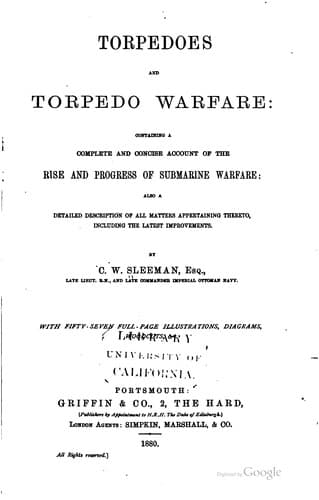
Torpedoes and Torpedo Warfare: Containing a Complete and Concise Account of the Rise and Progress of Submarine WarfareSleeman, Charles William
History
Torpedoes and Torpedo Warfare: Containing a Complete and Concise Account of the Rise and Progress of Submarine Warfare
Sleeman, Charles William
Torpedoes
"The most powerful combination that exists, in which number of
alternations is combined with extent of surface, is that constructed
by the subscription of a few zealous cultivators and patrons of
science in the laboratory of the Royal Institution. It consists of
200 instruments, connected together in regular order, each composed
of ten double plates arranged in cells of porcelain, and containing
in each plate thirty-two square inches; so that the whole number of
double plates is 2,000, and the whole surface 128,000 square inches.
This battery, when the cells were filled with sixty parts of water,
mixed with one part of nitric acid, and one part of sulphuric acid,
afforded a series of brilliant and impressive effects. When pieces
of charcoal about an inch long and one-sixth of an inch in diameter
were brought near each other (within the thirtieth or fortieth part of
an inch), a bright spark was produced, and more than half the volume
of the charcoal became ignited to whiteness, and by withdrawing the
points from each other, a constant discharge took place through the
heated air, in a space equal at least to four inches; producing a most
brilliant ascending arch of light, broad, and conical in form in the
middle. When any substance was introduced into this arch, it instantly
became ignited. Platina melted as readily in it as wax in the flame
of a common candle; quartz, the sapphire, magnesia, lime, all entered
into fusion; fragments of diamond, and points of charcoal and plumbago,
rapidly disappeared, and seemed to evaporate in it, even when the
connection was made in a receiver exhausted by the air pump; but there
was no evidence of their having previously undergone fusion."
The philosopher also showed that, when the Voltaic or electric arc is
produced in the exhausted receiver of an air pump, the phenomena are
as brilliant in character, and the charcoal points can be more widely
separated, thus proving that the electric light is quite independent of
the oxygen of the air for its support.
Owing to the crude nature of the Voltaic batteries of that day, and
also to the great expense of maintaining a large battery of that
nature, nothing practical resulted from Davy's discovery of the
electric or Voltaic arc. Professor Faraday, the great physicist, by
his discovery of the principle of magneto-electricity, has enabled
the electric light to be brought into practical use. As early as
1833 Pixii applied the principle practically in the construction of
a magneto-electric machine with revolving magnets; he was followed
by Laxton, Clark, Nollet, Holmes, and others, who made machines with
fixed magnets. In 1854 Dr. Werner Siemens, of Berlin, introduced the
"Siemens' Armature," which, from its compact form, permitted a very
high velocity of rotation in an intense magnetic field, giving powerful
alternating currents, which, when required, were commutated into one
direction.
Public-domain text, read in full here on John Shaqi.
Reviews
Reviews
No reviews yet
Be the first to share your thoughts on this work.
Elsewhere in the archive
Join the Discussion
Join the discussion
Sign in to leave a comment or review.
Sign InorCreate an account