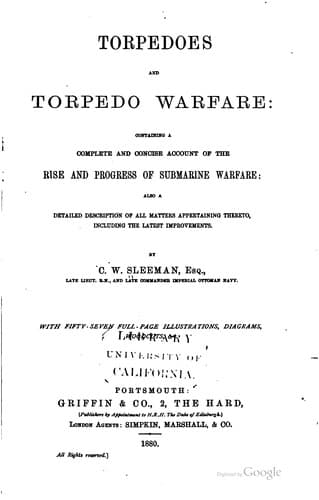
Torpedoes and Torpedo Warfare: Containing a Complete and Concise Account of the Rise and Progress of Submarine WarfareSleeman, Charles William
History
Torpedoes and Torpedo Warfare: Containing a Complete and Concise Account of the Rise and Progress of Submarine Warfare
Sleeman, Charles William
Torpedoes
As the electric arc is much too bright to be looked into with the naked
eye, both concentrating apparatus are supplied with a lens, called a
focus or flame observer, by means of which an image of the burning
carbons is thrown upon small screens at the back, so that the lamp can
be easily adjusted without fatigue to the eye. The focus observer is
shown on the lamp in holophote, Fig. 172.
_Precautions._--Before starting the apparatus, the electric lamp
terminals and those of the dynamo machine must be _connected up_ by
means of the leading wires provided with each set of apparatus. The
terminals are marked _C_ and _Z_ respectively, and they should be
connected, _C_ of machine to _C_ of the lamp, and _Z_ of the machine to
_Z_ of the lamp, in order that the electric current may be sent in the
proper direction through the carbons of the lamp. Should it, however,
be found that the top carbon (which should consume twice as fast as
that of the bottom one) does not consume so fast as the bottom one, it
may be assumed that the dynamo machine has reversed its poles, and the
leading wires will consequently require changing across. This reversal
of poles, though possible, is of _very rare_ occurrence.
[Illustration: Fig. 173.]
The dynamo-electric machine should not be driven without its proper
leading wires to lamp and lamp being connected up, or at least
an external resistance equivalent to that of the lamp (which is
approximately one Siemens' unit) must be inserted. In other words, the
machine must not be driven when a wire of small resistance connects the
two terminals _C_ and _Z_. This is expressed more briefly by saying the
machine must not be _short-circuited_. If it is short-circuited when
in motion the electric current becomes so powerful that it will leap
from segment to segment of the commutator, where very bright and large
sparks will be seen, and if continued would destroy the insulation,
thus weakening the current generated.
The leading wires should never be disconnected suddenly while the
machine is revolving at its full speed, as such a sudden interruption
will produce an intense spark, which will burn the ends of the wire
where the contact is suddenly broken. When it becomes necessary to
disconnect the wires, the belt should be pushed on to the loose pulley
by means of the striking gear, or the steam engine should be stopped.
It may be here stated that all connections should be cleaned bright and
screwed tightly, to ensure perfect metallic contacts being made.
_Coupling two Machines._--At Fig. 174 is shown a diagram of how to make
the connections when coupling two machines in parallel circuit. _MM'_,
_m_, _m'_, represent the ends of the wires of the electro-magnets;
_BB'_ are the branches; _C_ and _Z_ are the terminals of each machine
respectively.
[Illustration: Fig. 174.]
Public-domain text, read in full here on John Shaqi.
Reviews
Reviews
No reviews yet
Be the first to share your thoughts on this work.
Elsewhere in the archive
Join the Discussion
Join the discussion
Sign in to leave a comment or review.
Sign InorCreate an account