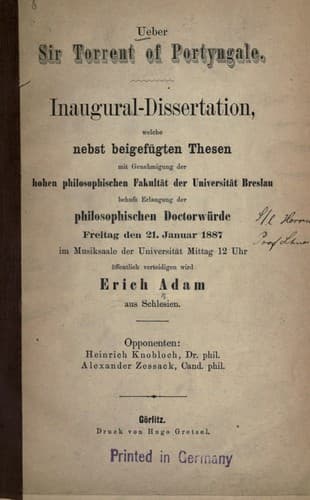
Knights and knighthood -- Poetry; Romances, English
p. 79, l. 2269 ff. It may be that ll. 2269-71 and ll. 2272-74 are to be
transposed, but I don’t think it necessary: Torrent’s men flee when they
see that their chief has surrendered.
p. 80, l. 2302. _wekid_ = wicked, mischievous. But I don’t recollect to
have met with this adj. as an epithet to _land_ or _country_.
p. 80, l. 2304. Cf. _Tristrem_, l. 88, Kölbing’s note to that passage,
and _York Plays_, p. 438, l. 155:
‘For, certys, my lyf days are nere done.’
p. 80, l. 2316. The alteration of this line is rather a radical one; but
there was no other way to restore the rhyme; I think that first, _day_
and _nyȝt_ had changed their places in line 2313, and then the copyist,
in order to get a rhyme to _nyȝt_, spoilt the latter line.
p. 81, l. 2335. _be my ffaye_ and _parmaffay_ in the same stanza, and
both in the rhyme, are rather poor; one of these lines may have run
thus:
‘Be god of heven, the king gan say.’
p. 82, l. 2357. The same confusion between _turment_ and _turnament_
occurs in _Ipomadon_, l. 2868; cf. Kölbing’s note to this line.
p. 83, l. 2392. Cf. _Ipomadon_, l. 3958:
‘A mercy, syr, for Crystes pitte,’
and Kölbing’s note to this line.
p. 83, l. 2395 f. Cf. Kölbing’s note to _Tristrem_, l. 3064, where he
cites an interesting parallel passage to this line from _Guy of
Warwick_, ed. Zupitza, l. 4707 f.:
‘Ȝyt þou art the trewest knyght,
That euer slepyd in wynturs nyght.’
p. 83, l. 2405. _and_ is perhaps miswritten for _an_ or _on_.
p. 83, l. 2407. This line, as it stands, is rather odd; perhaps it ought
to be identical with l. 1128.
p. 84, l. 2420. _juster_, _jouster_, means here a knight who joins in a
joust or tournament: in the only other passage where it is known to
occur, _Alis._, l. 1400, it is a horse for tourneying.
p. 84, l. 2433 = l. 2456; cf. _Ipomadon_, l. 8830:
’_Euery man in there degre._’
p. 85, l. 2450. On _roial_, cf. Kölbing’s note to _Ipomadon_, l. 64. To
_a roall ffyght_ may be compared Shakespeare’s _A royal battle_ (_Rich.
III._, IV. iv.).
p. 85, l. 2461. _with oute lent_ = ‘without fasting’? I have not met
with this expletive phrase anywhere else.
p. 86, l. 2493. It was not superfluous to mention this fact, because
knights were very often killed in tournaments; cf. Niedner, _Das
deutsche turnier im XII. und XIII. Iahrhundert_, Berlin, 1881, p. 24.
See also R. Brunne’s _Handlyng-Synne_, ed. Furnivall, 1862, p. 144-6.
p. 87, l. 2518-20. As to the meaning of _couplid_, cf. Mätzner,
_Wörterbuch_, I. p. 491. These lines evidently mean that gentlemen and
ladies sit alternately, what one calls in German, _bunte reihe machen_.
Cf. A. Schultz, _Das höfische Leben Zur Zeit der Minnesinger_, I.
p. 330, and P. Pietsch, Bunte Reihe, _Zeitschrift für deutsche
Philologie_, vol. xvi. Halle, 1884, p. 231, who cites from _Biterolf_,
l. 7399 ff.:
‘Do hiezens under mîne man
Ir ingesinde wol getân
Sich teilen in dem palas,
Daz kein mîn recke dâ was,
Ern sæze zwischen magedîn.’
Public-domain text, read in full here on John Shaqi.
Reviews
Reviews
No reviews yet
Be the first to share your thoughts on this work.
Elsewhere in the archive
Join the Discussion
Join the discussion
Sign in to leave a comment or review.
Sign InorCreate an account