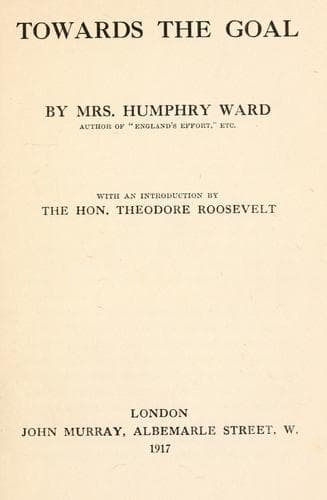
World War, 1914-1918 -- Campaigns -- Western Front; World War, 1914-1918 -- Personal narratives
But what has changed is _the food situation_, owing partly to submarine
attack, and partly to the general shortage in the food-supply of the
world. In one of my earlier letters I spoke with anxiety of the still
unsettled question--Will the house-wives and mothers of the nation
realise--in time--our food necessities? Will their thrift-work in the
homes complete the munition-work of women in the factories? Or must we
submit to the ration-system, with all its cumbrous inequalities, and its
hosts of officials; because the will and intelligence of our people,
which have risen so remarkably to the other tasks of this war, are not
equal to the task of checking food consumption without compulsion?
It looks now as though they would be equal. Since my earlier letter the
country has been more and more generally covered with the National War
Savings Committees which have been carrying into food-economy the energy
they spent originally on the raising of the last great War Loan. The
consumption of bread and flour throughout the country has gone down--not
yet sufficiently--but enough to show that the idea has taken
hold:--"_Save bread, and help victory_!" And since your declaration of
war it strengthens our own effort to know that America with her
boundless food-supplies is standing by, and that her man-and sea-power
are now to be combined with ours in defeating the last effort of Germany
to secure by submarine piracy what she cannot win on the battle-field.
Meanwhile changes which will have far-reaching consequences after the
war are taking place in our own home food-supply. The long neglect of
our home agriculture, the slow and painful dwindling of our country
populations, are to come to an end. The Government calls for the sowing
of three million additional acres of wheat in Great Britain; and
throughout the country the steam tractors are at work ploughing up land
which has either never borne wheat, or which has ceased to bear it for
nearly a century. Thirty-five thousand acres of corn land are to be
added to the national store in this county of Hertfordshire alone. The
wages of agricultural labourers, have risen by more than one-third. The
farmers are to be protected and encouraged as they never have been since
the Cobdenite revolution; and the Corn Production Bill now passing
through Parliament shows what the grim lesson of this war has done to
change the old and easy optimism of our people.
Public-domain text, read in full here on John Shaqi.
Reviews
Reviews
No reviews yet
Be the first to share your thoughts on this work.
Elsewhere in the archive
Join the Discussion
Join the discussion
Sign in to leave a comment or review.
Sign InorCreate an account