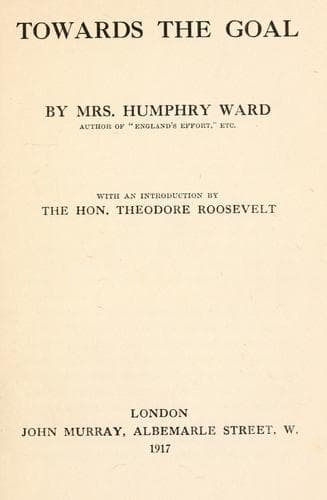
World War, 1914-1918 -- Campaigns -- Western Front; World War, 1914-1918 -- Personal narratives
DEAR MR. ROOSEVELT,--Shall I ever forget that broad wintry plateau of
the Ourcq, as it lay, at the opening of March, under its bed of snow,
with its ruined villages, its graves scattered over the fields, its
utter loneliness, save for the columns of marching soldiers in the
roads, and the howling wind that rushed over the fields, the graves, the
cemeteries, and whistled through the gaping walls of the poor churches
and farms? This high spreading plain, which before the war was one scene
of rural plenty and industrious peace, with its farm lands and orchards
dropping gently from the forest country of Chantilly, Compiègne, and
Ermenonville, down to the Ourcq and the Marne, will be a place of
pilgrimage for generations to come. Most of the Battle of the Marne was
fought on so vast a scale, over so wide a stretch of country--about 200
miles long, by 50 broad--that for the civilian spectator of the future
it will never be possible to realise it as a whole, and very difficult
even to realise any section of it, topographically, owing to the
complication of the actions involved. But in the Battle of the Ourcq,
the distances are comparatively small, the actions comparatively simple
and intelligible, while all the circumstances of the particular struggle
are so dramatic, and the stakes at issue so vast, that every incident
is, as it were, writ large, and the memory absorbs them more easily.
An Englishwoman, too, may be glad it was in this conspicuous section of
the battle-field, which will perhaps affect the imagination of posterity
more easily than any other, that it fell to the British Army to play its
part. To General Joffre the glory of the main strategic conception of
the great retreat; to General Gallieni the undying honour of the rapid
perception, the quick decision, which flung General Maunoury, with the
6th Army, on Von Kluck's flank and rear, at the first hint of the German
general's swerve to the southeast; to General Maunoury himself, and his
splendid troops, the credit of the battle proper, across the broad
harvest fields of the Ourcq plateau. But the advance of the British
troops from the south of the Marne, on the heels of Von Kluck, was in
truth all-important to the success of Maunoury on the Ourcq. It was the
British Expeditionary Force which made the hinge of the battle-line, and
if that hinge had not been strong and supple--in all respects equal to
its work--the sudden attack of the 6th Army, on the extreme left of the
battle-line, and the victory of General Foch in the centre, might not
have availed. In other words, had Von Kluck found the weak spot he
believed in and struck for, all would have been different. But the weak
spot existed only in the German imagination. The British troops whom Von
Kluck supposed to be exhausted and demoralised, were in truth nothing of
the sort. Rested and in excellent condition, they turned rejoicing upon
the enemy, and, in concert with the French 6th Army, decided the German
withdrawal.
Public-domain text, read in full here on John Shaqi.
Reviews
Reviews
No reviews yet
Be the first to share your thoughts on this work.
Join the Discussion
Join the discussion
Sign in to leave a comment or review.
Sign InorCreate an account