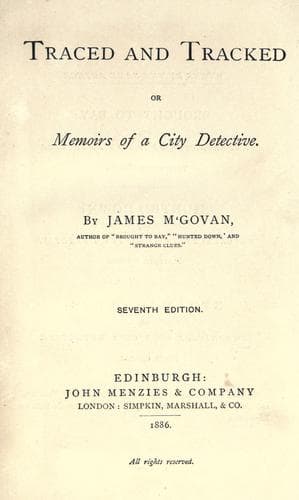
Traced and Tracked; Or, Memoirs of a City DetectiveM'Govan, James
General
Traced and Tracked; Or, Memoirs of a City Detective
M'Govan, James
Detective and mystery stories; Edinburgh (Scotland) -- Fiction
“So much the better,” returned the photographer, not to be daunted.
“She’ll want your portrait exactly as you stand—not as you were
before this voyage, or when you were courting her. Folks’ faces
change so soon.”
“Maybe they do, but their hearts remain the same,” returned the
sailor cheerily.
“Well, not always—they change, too, sometimes,” said Turnbull, with
the air of one who had bitterly experienced the truth of his words;
“but with your portrait always beside her, her heart couldn’t change.
Just step in—I won’t keep you a moment, and you can take it with
you. You’ll have it, and she’ll have it, long after the races are
forgotten.”
The sailor easily yielded, and followed him into the tent, and then
Turnbull, having now a professional interest in the man, took notice
of his dress and appearance particularly for the first time. The
man was low in stature, thick set, and evidently a powerful fellow.
He wore an ordinary sailor’s suit of dark blue, but had for a
neckerchief a red cotton handkerchief loosely rolled together, and so
carelessly tied that the ends hung down over his breast.
In order to get all the sailor’s face into the portrait, Turnbull
with some difficulty persuaded him to remove his cap, and then drew
from him an admission that his objection arose from the fact that
there was a flesh mark on one side of his forehead which he did not
wish to appear in the portrait. The difficulty was got over—as it
was with Hannibal—by taking a side-view, and the first attempt came
out all right, so far as the portrait was concerned. But the sailor
wished to appear as if he had just removed his cap, and with that in
his hand, so the first was put aside as spoilt, and another taken,
which, though not so successful, pleased the owner better, as in
that the cap appeared in his hand. The portrait was finished and
framed, and so free and good-natured was the owner that he insisted
on paying for the spoilt one, which, however, he refused to take
with him. While Turnbull had been putting a frame on the portrait,
the sailor took out a long piece of tobacco and a pocket knife and
cut himself a liberal quid, at the same time offering a piece to the
photographer, which was accepted. The knife with which the tobacco
was cut was a strong one, with a long, straight blade and a sharp
point.
The whole transaction over, they bade each other good-day, and the
sailor disappeared among the crowds of spectators and betting men
on the course with the avowed intention of enjoying himself, and
scattering some money before he went home.
Public-domain text, read in full here on John Shaqi.
Reviews
Reviews
No reviews yet
Be the first to share your thoughts on this work.
Elsewhere in the archive
Join the Discussion
Join the discussion
Sign in to leave a comment or review.
Sign InorCreate an account