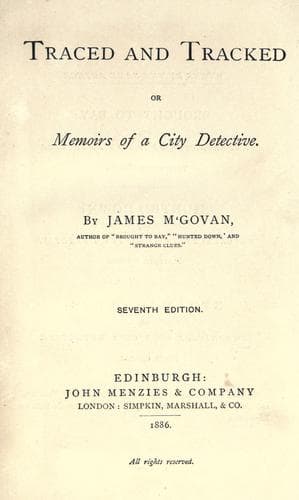
Traced and Tracked; Or, Memoirs of a City DetectiveM'Govan, James
General
Traced and Tracked; Or, Memoirs of a City Detective
M'Govan, James
Detective and mystery stories; Edinburgh (Scotland) -- Fiction
Questioned by me, she could not say whether the sailor had used a
knife. Her idea was that he had only given the man a drive with his
hand to knock him down or get him out of the way. The sailor spoke in
a low tone; M^cCulloch was noisy and defiant. She saw no knife in the
sailor’s hand, and was sure he was a stranger. She did not think she
would know him again, as she did not look at his face, but she knew
every one about the town, and was positive that the sailor did not
belong to the place. It was the sailor who stopped M^cCulloch, whom
he seemed to know; and she thought he was quite sober, though pale
and angry-looking. “Look me in the face and say it’s not true,” were
the only words she could remember hearing, and they were spoken in a
fierce tone by the sailor, just as she was getting beyond earshot.
Having thus a little to work upon, I tried all the exits of the
town for some trace of him, without success. He had not gone away
by rail or coach, and no one had seen him leave on foot, so far as
I could discover; but that was to be expected in the state of the
town. Dozens of sailors with red neckties might have come and gone
and never been noticed in such a stir. In the town itself I was
more successful. To my surprise I found that a man answering the
description had visited nearly every public-house in the place. He
had never spoken or called for drink; he had merely looked through
the houses in a pallid, excited manner, and gone his way.
“He seemed to be looking for some one,” a publican said to me, “but
he was gone before I could ask him.”
I spent a good deal of time in the place, though not sure that if
I got that man I should be getting the murderer, and returned to
Edinburgh with the last train. I went back again next morning, and
found M^cCulloch still alive, and sensible enough to be able to give
an assent or dissent when asked a question. But about the murderous
attack upon himself he could not or would not give a sign. He would
only stare, or shut his eyes, or turn away. The doctor thought he did
not understand me—that the patient’s head was not yet quite clear;
I thought quite the reverse. The same curious circumstance occurred
when it was suggested that his deposition should be taken. M^cCulloch
had no deposition to make, or would not make one. He seemed quite
prepared to die and give no sign.
Not an hour later I was favoured with a visit from Turnbull, the
travelling photographer. He had been lodging in the town, and of
course had heard of the strange crime. He had heard also of my
unsuccessful hunt for the sailor, and would probably have gone up to
Edinburgh to see me had he not been loth to lose another day at the
race-course, his stance being taken for three days.
I could not conceive what the lank, hungry-looking being could want
with me, or why there should be about his lean jaws such a smirk of
intense satisfaction, as he gave his name and occupation.
Public-domain text, read in full here on John Shaqi.
Reviews
Reviews
No reviews yet
Be the first to share your thoughts on this work.
Elsewhere in the archive
Join the Discussion
Join the discussion
Sign in to leave a comment or review.
Sign InorCreate an account