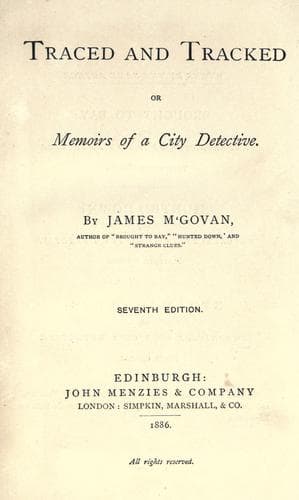
Traced and Tracked; Or, Memoirs of a City DetectiveM'Govan, James
General
Traced and Tracked; Or, Memoirs of a City Detective
M'Govan, James
Detective and mystery stories; Edinburgh (Scotland) -- Fiction
To Leith accordingly I went, and found The Shannon, her cargo already
discharged, and only a few of the men on board. Some had been paid
off and some were off for a few days on leave. The man whom I
questioned—for the captain had gone home too—seemed to me sullen and
suspicious. He did not know if one of the men had gone eastwards to
see his wife; if any of them lived in that quarter he had never heard
of it, and so on. I was dissatisfied with the answers and the man’s
manner, and had he resembled in the slightest degree the portrait in
my pocket I should have arrested him on the spot. I thought I would
bring out the photograph as a test. Holding it up before him, I said
sharply—
“Do you know that man?”
“No, I don’t.” The answer came out almost before he had time to look
at the features. It was too prompt. It was a lie. The falsehood told
me more than the truth would have done. It not only convinced me that
I was at least on the track of the photographed sailor, but roused in
my mind for the first time a strong suspicion that he was the knifer
of M^cCulloch. I went from the ship to the shipping agents. I found
the clerk who had handed their pay to all the men; and on producing
the photograph saw that he recognised it instantly.
“Yes, that was one of them,” he said, “but he was paid off, and has
gone home.”
I asked the man’s name, and, on referring to the books, he gave it as
Tom Fisher. With some difficulty he got me the man’s address—which
was in a town some miles east—and his trouble arose from the fact
that no money had been sent to Fisher’s wife for nearly a year.
The sailors’ wives often drew one half the men’s pay, but she had not
applied for it during that time, and was supposed to have changed her
address.
“I didn’t say anything of it to Fisher,” said the clerk in
conclusion, “and he seemed quite elated at having so much money to
draw. It’s a kittle thing interfering between a man and his wife, and
it might have alarmed him needlessly. If there’s anything wrong he’s
best to find it out himself.”
I left the shipping office, and took the first train for the town in
which Fisher had his home. If he was to be found anywhere, I thought
it would be there—and especially so if he turned out to be innocent.
It is a quiet country place in which everyone knows his neighbours,
and I had no difficulty in finding the house. But it was occupied by
an old woman, who said she had been in it for nearly a year. I asked
for Mrs Fisher, the sailor’s wife.
“Oh, she was a bad lot,” was the blunt rejoinder. “She sellt a’ her
things, bit by bit, and gaed awa’ in the end withoot paying her rent
and other debts.”
“Where did she go to, do you know?”
“Oh, dear kens. She was a drunken hussy, and thought hersel’ bonny.
Some say that she went awa’ wi’ a baker-man they ca’ M^cCulloch, and
was aboot Leith for a while, but maybe it’s no true. He used to hae a
great wark wi’ her.”
“And her husband—has he never been here?”
Public-domain text, read in full here on John Shaqi.
Reviews
Reviews
No reviews yet
Be the first to share your thoughts on this work.
Elsewhere in the archive
Join the Discussion
Join the discussion
Sign in to leave a comment or review.
Sign InorCreate an account