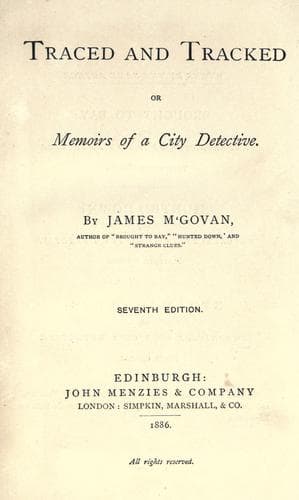
Traced and Tracked; Or, Memoirs of a City DetectiveM'Govan, James
General
Traced and Tracked; Or, Memoirs of a City Detective
M'Govan, James
Detective and mystery stories; Edinburgh (Scotland) -- Fiction
I did not hear any more, for I was in a hurry, and the roll that
morning rather long, but the appealing face, the tears, and hurriedly
breathed outpourings of that poor mother’s heart, followed me
right into the court-room. Frantic and voluble appeals under such
circumstances are common, but this one was quiet, sudden, and
overpowering. I looked at the prisoner for the first time with
special interest. He was a young lad of sixteen or so, rather
strongly built, and manly-looking, but, of course, hanging his
head in shame as they generally do the first time. The case was a
very simple one. Jim was an apprentice plumber in a big workshop;
quantities of brass-fittings, copper wire, and tin had been missed,
and at last I was set to watch the workers. I followed several
innocent ones for a time, but at length came to Jim. I should have
overlooked him, for he had rather an innocent face, but for a certain
bulkiness about his body. Jim did not go straight home, but took a
certain broker’s on the way. He went through to the back shop, and I
surprised him there in the act of unloading. The broker, of course,
protested perfect innocence, but I took them both. The broker got
off by some means, and Jim now stood there alone. The charge was
theft, and confined to the articles taken with him, though that did
not cover a hundredth part of his pilferings. Was he guilty?
“Yes sir, guilty,” was Jim’s hurried answer, with his head lower on
his breast.
“Hae mercy on him!” rang out from the benches behind in the
unmistakable tones of Jim’s mother, as the magistrate paused in
doubt, possibly feeling to send such a fine lad to prison. “Let him
off this time, and he’ll never come back again.”
I was motioned to the side of the magistrate to give my opinion in an
undertone. I did try to make it light for the lad. I said I thought
he had been prompted to the acts by some one who was uncaught, that
his home training had been against such a course, and that he had
never been in court before. But I could not refute the statements of
his employers, that their losses had extended over more than a year,
and been serious indeed. A few moments thought, and the magistrate
spoke out without comment of any kind—“Thirty days.”
There was an impassioned outcry in a woman’s voice, but I did not
turn in that direction, as I did not want to see anything. I hurried
out the prisoner by the side door a moment or two later, and was
again clutched by the mother.
“He’ll come oot waur than he gangs in,” she exclaimed in despairing
accents, and with bitter reproach.
“Exactly, there’s little doubt of that,” I answered with assumed
coolness.
“Is that a just punishment?” she pursued, almost choked with tears,
as she clung to the arm of her son, who now seemed to shrink from her
in shame, and to long for the seclusion of the cells.
“It’s the Nemesis of crime—the chief part of the punishment,” I
returned; “they should think of that before they begin.”
Public-domain text, read in full here on John Shaqi.
Reviews
Reviews
No reviews yet
Be the first to share your thoughts on this work.
Elsewhere in the archive
Join the Discussion
Join the discussion
Sign in to leave a comment or review.
Sign InorCreate an account