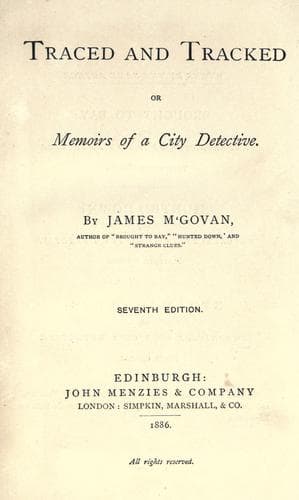
Traced and Tracked; Or, Memoirs of a City DetectiveM'Govan, James
General
Traced and Tracked; Or, Memoirs of a City Detective
M'Govan, James
Detective and mystery stories; Edinburgh (Scotland) -- Fiction
This was said laughingly. Coglin took the herring, affected to sniff
at it, and then, with an expression of disgust, threw it back.
Burfoot’s mouth was open, and the pitched herring dived into the
cavity as neatly as if it had really been, what the hawker asserted,
“living.” Burfoot sputtered and choked, while the tailor above,
though wishing the quarrel to go the other way, could not restrain
a burst of laughter at the comical appearance the hawker cut. There
is a limit even to the endurance of a peaceable man. Burfoot no
sooner was free of the unexpected mouthful than he wildly grabbed
a handful of herrings from the cart, and battered them, as fast as
he could fire them, in the direction of the baker’s head. Coglin
retreated and closed the bakehouse door, and after some storming and
threatening Burfoot picked up the missiles he had used, tossed them
back into the cart, and drove on, shouting “Fine fresh herrings!”
Four or five of them, which had been dashed in at the open door at
the retreating baker, that worthy gathered up and complacently put
into a dish in the oven for his dinner. He was in a good temper,
for he thought he had got decidedly the best of the quarrel. He was
to change his mind next morning. Coglin’s business was a small one,
and, except at specially busy times, he did all his baking himself.
He was therefore the first and only one on the spot next morning.
The hour was an early one, but it was quite light, and he noticed at
once that something was wrong. The principal window to the bakehouse
had been raised, and the lower sash left wide open. The circumstance
excited his curiosity and surprise, but did not at first greatly
concern him. There was little of value in the bakehouse for thieves
to take, and he thought the raising of the sash might be only the
trick of some mischievous boy. He unlocked the door and got inside,
looked around the place, and then groaned and cursed to his heart’s
content. The batch for his early baking had been carefully “set” the
night before, that is, the dough had been carefully mixed in a wooden
trough, covered over with a board and some empty sacks, and left to
“rise.” It had not risen as he had expected, for the coverings had
been removed; his bakehouse “bauchles” had been stuck into the soft
mass, with all the shapes and biscuit markers, and a dirty can of
sugar and water, with its paint-brush, with which he anointed cookies
when they came hot from the oven, added on the top. That was not all.
A bag half-full of flour, which generally stood in a corner, had been
dragged forward and turned out on the floor, while into the white
heap had been poured his whole supply of barm.
When he had quite exhausted his stock of language, Coglin rose, and,
closing the window and door, made his way to the chief constable’s
house, where he roused that worthy man out of bed, and insisted upon
him dressing and coming to see the wreck.
Public-domain text, read in full here on John Shaqi.
Reviews
Reviews
No reviews yet
Be the first to share your thoughts on this work.
Elsewhere in the archive
Join the Discussion
Join the discussion
Sign in to leave a comment or review.
Sign InorCreate an account