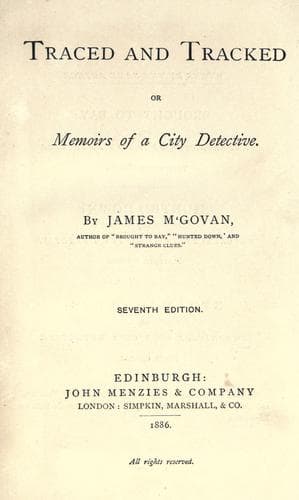
Traced and Tracked; Or, Memoirs of a City DetectiveM'Govan, James
General
Traced and Tracked; Or, Memoirs of a City Detective
M'Govan, James
Detective and mystery stories; Edinburgh (Scotland) -- Fiction
“And you call yourself a detective?” he scornfully shouted, and his
private opinions which followed are not worth recording.
“I believe that is what I am called, and what I earn my bread by,” I
quietly returned.
“Well, I’ll tell you what you are!” he shouted, working himself
nearly black in the face; and he then proceeded to declare that I had
been bought over by his enemies, and that he would now trust, not to
the police or the law for redress, but to himself. He looked so like
a maniac in his rage and fury, that I did not trouble to reply, but
left him and got back to Edinburgh, where other work soon drove the
recollection of the baker’s petty affair out of my head.
Coglin’s detective work did not begin where mine left off. He had
quite settled in his own mind who was the guilty one, and his only
difficulty was to decide on what punishment should be meted out to
the herring hawker. Many plans suggested themselves, but they mostly
had the objectionable feature of bringing the self-appointed judge
and executioner within reach of the law. At length a chance remark of
Burfoot—who, all unconscious of impending evil, was still on friendly
terms with the baker—prompted him to a scheme as ingenious as it was
diabolical. A son and heir had been born to Burfoot, and he gleefully
told the baker that he should soon hold a party of rejoicing over the
event, when the christening could conveniently take place. He did not
invite Coglin to form one of the party, but that oversight did not
distress the baker.
“I wish I could poison the whole of them,” was his inward comment as
he turned to his bakehouse, and out of that remark sprang the great
scheme.
Coglin of course knew something of the baking of fancy bread, and
the same evening, as soon as his ordinary work was over, he set to
and made a fine christening cake. He was careful to cover up the
windows and every chink in the door before beginning. In making up
the cake he hesitated long between some arsenic which he had got for
the rats in the bakehouse and another powerful drug as a seasoning;
but, having made his choice and hurried up the cake, he waited and
watched the firing of it as eagerly and attentively as if a Princess
Royal had been intended as the joyful recipient. The cake did not
rise well, probably owing to the queer spicing it had got, but Coglin
chucklingly decided that the sugaring would cover that. He snowed it
over with a preparation of white sugar, and then flowered it over the
corners and edges with pink, and finished up by lettering it boldly
in sugar as “A Present from Edinburgh.”
Public-domain text, read in full here on John Shaqi.
Reviews
Reviews
No reviews yet
Be the first to share your thoughts on this work.
Elsewhere in the archive
Join the Discussion
Join the discussion
Sign in to leave a comment or review.
Sign InorCreate an account