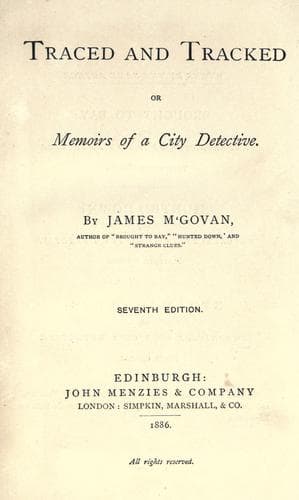
Traced and Tracked; Or, Memoirs of a City DetectiveM'Govan, James
General
Traced and Tracked; Or, Memoirs of a City Detective
M'Govan, James
Detective and mystery stories; Edinburgh (Scotland) -- Fiction
When Peter had been in the mill for nearly a year, the manager asked
him if he would like to learn a trade instead of to be a tenter.
Peter was willing, and was taken into the mechanics’ shop attached to
the mill, there to learn to make and fit up machinery. He grew stout
and sturdy, and gave great satisfaction, as he never seemed happier
than when tearing in at his work. He never dared to write home, and
was mourned as one dead. In six years Peter became a full-fledged
journeyman. He was now a tall, strapping fellow, with a good face,
and a clear, laughing eye, and was qualified to go anywhere and
command a high wage as a first-class engine-fitter. He had been
diligent and steady, and had studied drawing and designing to help
him in his trade, and altogether was quite a different character from
what he had promised as a small and terrible burglar. He had even
saved a little money, and it was the thought of that money lying
idle, and the heaps more which he was now able to earn, which sent
his thoughts homewards and his heart throbbing for dear Auld Reekie.
When he had been a few weeks journeyman, and engaged in the same mill
at a capital wage, the Fair holidays came on, and Peter’s eye caught
a bill announcing a “Trip to Edinburgh.” Edinburgh! The very sight
of the word thrilled him through. He got a ticket and went through
next day. He made his way first to Hill Place. His parents had not
lived there for years. No one knew them, or had heard of them, and he
began to faintly wonder if they could have been all starved to death
at that fearful time when he was locked up in prison as a burglar.
Then he thought of the bakers’ house of call, and went thither and
got a great lift to his heart. His father was alive and doing well
as foreman to Borland the baker, who had now two shops, and was
flourishing also. Peter went to the principal shop, and found Mr
Borland behind the counter. As he entered the shop a floury-faced
man, in his shirt sleeves, was leaving for the regions below, and the
young engine-fitter stared into the face with a palpitating heart.
“That’s my faither! that’s my faither!” he thought, with a great lump
rising in his throat; but he could no more have spoken than he could
have flown in the air.
Borland stared at him curiously, and thought from his incoherent
words and strange manner that the stranger was drunk. At length he
understood that the young man wished to be directed to the home of
Mossman, the foreman, and, as he refused to see the foreman, he got
the address and departed. Mossman came up from the bakehouse a few
minutes later, and was apprised of the circumstance, but thought
nothing of it till he was half-way down the stair again. Then
something familiar in the face he had seen for a moment in the shop
had flashed upon his memory, and he dashed up to the shop, whiter
than the flour on his face, and faintly staggered towards his friend
and master, Borland, with the words—
Public-domain text, read in full here on John Shaqi.
Reviews
Reviews
No reviews yet
Be the first to share your thoughts on this work.
Elsewhere in the archive
Join the Discussion
Join the discussion
Sign in to leave a comment or review.
Sign InorCreate an account