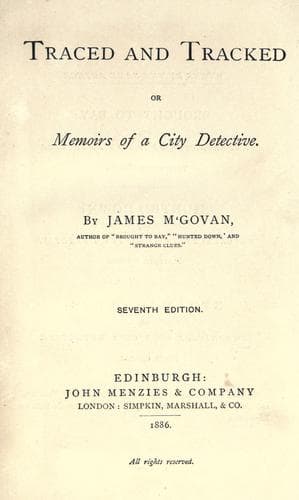
Traced and Tracked; Or, Memoirs of a City DetectiveM'Govan, James
General
Traced and Tracked; Or, Memoirs of a City Detective
M'Govan, James
Detective and mystery stories; Edinburgh (Scotland) -- Fiction
nearly gone from my thoughts, when on the South Bridge, near the head
of Infirmary Street, I came up to a wretchedly-clad woman bearing
in her arms a child, round which was wrapped a gaudy and apparently
new shawl of the exact pattern I sought. Now, at the first glimpse
of this shawl I decided that it was not the one I sought, which
I imagined would scarcely be so bright and fresh-looking; but it
was the incongruity of that bright shawl, allied to such rags and
poverty, which made me slacken my pace, and almost instinctively
follow the owner of the child.
The woman was not a professional thief—a glance at her somewhat
pinched features told me that—yet her poverty was so apparent that I
felt by no means certain that she would not have committed a robbery
under such pressure. Poverty and a hungry bairn—where is the mother
who could resist the pleadings of these? Then the shawl was the only
fresh thing about the queer pair. The mother’s clothes were meagre
and shabby in the extreme; her boots were mere apologies for foot
coverings, and her bonnet only fit for a scarecrow, and the clothing
of the child equally poor. They had also a worn and travel-stained
look, and stood out prominently among the ordinary passengers as
dusty tramps always do when they enter a city. They were strangers,
they were poor, and the child wore a tartan shawl of the exact
pattern I sought—it could do no harm to follow them, which I did with
a sigh for the dinner I had hoped so soon to be consuming.
My interesting pair turned down Infirmary Street, and stopped at the
gate of that institution—became, indeed, part of a crowd already
gathering there—visitors waiting the hour of admittance to see
friends. Five o’clock was the hour, and it lacked nearly ten minutes
of the time. Most of these visitors were of the poorest, and they
varied the monotony of the waiting by exchanging experiences and
expressions of sympathy. My tramp joined in the conversation, and
I soon learned from her tongue that she came from the West. The
Glasgow brogue was strong in her tongue, but not strong enough, and
I soon heard her say that she had come from Airdrie, which accounted
for the slight difference in the accent. She was the wife of a pit
labourer—an occupation considered far beneath that of a collier, who
ranks as a skilled workman; and her husband in working among the
hutches had got hurt in some way, and been laid up at home till their
little house was almost stripped of furniture. Then the disabled man
had gone to Glasgow for advice; and afterwards hearing of the great
skill of the Edinburgh professors, he had scraped together enough to
bring him through to this Infirmary, into which he was admitted as
an indoor patient. He did not write very hopefully of recovery; and
at length the wife, reduced to her last penny, had resolved to come
through and see him with her own eyes.
Public-domain text, read in full here on John Shaqi.
Reviews
Reviews
No reviews yet
Be the first to share your thoughts on this work.
Elsewhere in the archive
Join the Discussion
Join the discussion
Sign in to leave a comment or review.
Sign InorCreate an account