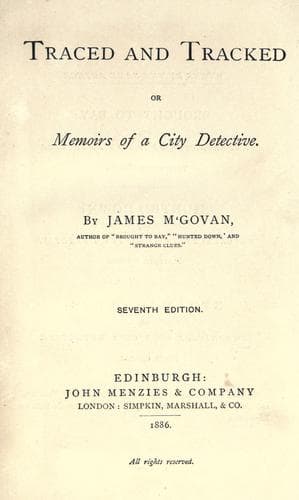
Traced and Tracked; Or, Memoirs of a City DetectiveM'Govan, James
General
Traced and Tracked; Or, Memoirs of a City Detective
M'Govan, James
Detective and mystery stories; Edinburgh (Scotland) -- Fiction
A lovely sunset was shedding glory on the scene, and all was peaceful
but the mind of that lost man. In looking listlessly around, his eye
fell on a comfortable and well-sheltered residence, the very air of
which proclaimed it, to Johnston’s experienced eye, a minister’s
manse. There was a large garden attached, well stocked with fruit
trees and bushes, and every other appurtenance that could render a
country house snug and attractive. I don’t know whether the thought
struck him that he might have been the comfortable occupant of such
a house—possibly it did, for he was conscious that he had more
talent than dozens of the drones occupying manses of the kind—but
his immediate action was to rouse himself to consider whether he
could not lay the occupant under contribution. A passing field hand,
belonging to the village close by, supplied him with the occupant’s
name and opinions, and, thus armed, he ventured up to the house,
gently rang the bell, and with some difficulty induced the servant to
take up his name—“The Rev. Alfred Johnston”—to her master.
Johnston stood demurely in the lobby, to which he had been admitted
with marked suspicion by the servant, till the Rev. Robert Goodall
appeared, in spectacles and slippers, direct from his study. If
he had been startled to learn that a brother clergyman wished to
see him, he was much more so at seeing the brother clergyman. But
Johnston was fluent of tongue, and he had experience in dealing with
such surprise.
“I am really a clergyman, as I can prove to you, but have been
reduced to this state by my own folly,” he hastened to humbly say.
“And I have not come to beg or ask you for money, as I daresay there
are so many legitimate calls upon your goodness that you can ill
afford to succour strangers. But I have walked all the way from
Glasgow, and am now nearly fainting with hunger. If you could tell
your servant to give me, out on the door-step or at the road-side,
enough broken victuals, no matter how plain or coarse, to support me
till morning, your kindness will never be forgotten.”
The clergyman heard him in silence, and probably scepticism; but
on questioning him closely as to his college career, was surprised
to find every statement agreeing with his own knowledge. Johnston
described the classes; mimicked the Professors; quoted Greek and
Hebrew writings with the utmost ease and correctness, and even showed
that he had made the acquaintance of personal friends of Mr Goodall
who had attended during the same sessions. In this narration Johnston
had only to keep to the truth to make it saddening to listen to, and
this he did, adding a few pathetic touches about a wife and child
left in great want in Glasgow, while he made a struggle to reach
Edinburgh on foot, in hope of securing a tutor’s place, for which he
was well qualified.
“Do you mean to try to reach Edinburgh to-night?” inquired the
clergyman, with some pity in his tones.
Public-domain text, read in full here on John Shaqi.
Reviews
Reviews
No reviews yet
Be the first to share your thoughts on this work.
Elsewhere in the archive
Join the Discussion
Join the discussion
Sign in to leave a comment or review.
Sign InorCreate an account