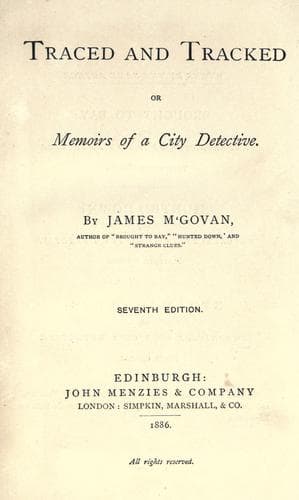
Traced and Tracked; Or, Memoirs of a City DetectiveM'Govan, James
General
Traced and Tracked; Or, Memoirs of a City Detective
M'Govan, James
Detective and mystery stories; Edinburgh (Scotland) -- Fiction
This seemed not bad at all, and quite worthy of the man who had so
neatly befooled M^cSweeny, but I only grinned unfeelingly in his
simple face, and said dryly that “I believed so,” and bundled him
without ceremony into the gig.
“But—but—ye don’t mean to tell me ye’re going to take me instead of
him?” he at length articulated, with a look of half-comical alarm.
“I am—just.”
“Then the real man’ll get off, and I’ll be hanged in his stead!” he
cried, fairly breaking down with terror; “for he’s footing it out
fast enough, I tell ye.”
“The real man?” I said, thinking to humour him, as I resumed the
reins and turned the horse’s head; “and what was he like, pray?”
“A clean-shaved, smooth-spoken gentleman—for all the world like a
priest or a minister, only that his head’s cropped as close as if
he was just new out of jail,” was the prompt answer; “though, by my
troth, he looked more like a shockerawn in my old duds when I left
him.”
I started, and began to think. Then I pulled off my prisoner’s hat,
and found his hair not at all close cropped. I drove rapidly back to
one of those wayside stations of the county police, and there left my
prisoner safely locked up, every question he answered confirming my
impression that he had been speaking the truth. The only difficulty
I had with him was in getting him to describe the clothes which he
had exchanged for the old blacks he wore. These he either could not
or would not name—in colour, shape, or material—a difficulty which I
only understood when the rags were before me—and then it would have
puzzled _me_ to do what I wondered at him not doing. Even a detective
can be unreasonable at times.
Leaving the Irish-speaking man thus, I turned the horse’s head and
made him spin along the road at a fine rate, being not only anxious
to overtake the wearer of the “duds,” if he existed, but also to
escape a storm of rain which had been threatening for half the day
and was then beginning to descend. When I had gone on thus for
a few miles, and passed a good many on the road—not one of whom
answered the description of my man—I allowed the horse to “breathe”
in ascending one of the braes by laying the reins on his neck and
letting him take his own pace. In thus moving slowly along, I turned
a corner allotted to stone breaking, and there caught sight of a dark
object huddled in to shelter from the rain. I was all but past, and
had just noticed that the figure was that of a ragged tramp, when the
man rose and trotted hurriedly after the gig, saying respectfully—
“If you please, sir, would it be asking too much, sir, for you to
give me a lift?”
I pulled up the horse and scanned him closely, while I appeared to
busy myself pulling up my collar to keep out the driving rain.
“Well,” I said, in a tone by no means gracious or obliging, “how far
are you going?”
“I’m not particular, sir,” he answered with alacrity, “as far as
you’re going yourself, sir.”
“Come up, then.”
Public-domain text, read in full here on John Shaqi.
Reviews
Reviews
No reviews yet
Be the first to share your thoughts on this work.
Elsewhere in the archive
Join the Discussion
Join the discussion
Sign in to leave a comment or review.
Sign InorCreate an account