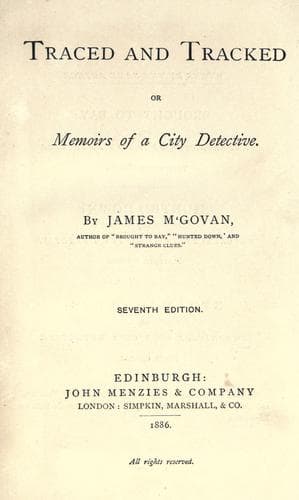
Traced and Tracked; Or, Memoirs of a City DetectiveM'Govan, James
General
Traced and Tracked; Or, Memoirs of a City Detective
M'Govan, James
Detective and mystery stories; Edinburgh (Scotland) -- Fiction
“Maybe he helped her in,” darkly suggested a third. “I’ve seen them
often walking here thegither, and he’s a perfect brute when he’s in a
passion. He wad ding her in as sune as look at her.”
This last suggestion found most acceptance. These men knew Smeaton
thoroughly—his fiery temper, brutal strength, and impulsive
ferocity—and had little doubt but his hand had sent the poor girl to
her watery grave. Their only difficulty was how to act in the dilemma.
One thought that it would be safest, in order to avoid awkward
questioning by those in authority, to quietly slip the body into
the water again, stow away their net in its usual hiding-place, and
drop work for the night; but this proposal was not well received,
for Jessie was a general favourite, and was admired from a distance
by the roughest in the place. While they stood thus in doubt, one of
them suddenly exclaimed—
“Deid folk dinna bleed! She’s maybe living yet—let’s gie the puir
thing a chance—row her on the grass—lift up her airms—dae onything
that’s like to bring her roond.”
The result of this electrifying speech was that the whole gang lent
a hand in the rough and ready means of restoration, and, with such
good effect, that very shortly the supposed drowned girl gave signs
of life, though not of consciousness. Thus encouraged, the men made a
litter of their coats, and ran with her to the nearest cottage, where
she was put to bed, and tended and nursed as carefully as if she had
been in her own home.
Jessie’s parents were sent for and informed as gently as possible
of the accident, and their first exclamation on reaching their
daughter’s side was—“Oh, the villain! this is Smeaton’s wark!”
Jessie was able to recognise her father, and smile faintly when he
took her hand in his own, but she was too weak to give any account of
the accident or crime till next morning. By that time the flight of
Smeaton had been discovered, and telegrams despatched ordering his
arrest and detention; and when Jessie woke she found not only the
lieutenant of police, but a magistrate at her bedside, ready to hear
her statement and act upon her charge. Then they all were surprised
to find that Jessie had no charge to make. She would not, by as much
as a look, admit that Smeaton had thrown her into the water, or even
struck her so as to cause her to fall in or receive the wound on her
temple. How had the accident happened then?
“I must have fallen in,” said Jessie, after a long pause, and with
tears in her eyes.
“Yes, you must have fallen in,” impatiently interposed her father,
who positively hated her lover, “or you could never have been picked
out, but was the falling in purely accidental? Surely, Jessie, I have
trained you well enough in truthfulness to be able to rely on your
answer in a matter of life and death?”
“Yes, father, dear,” meekly answered Jessie, with fresh tears. “I
will always be truthful. But I cannot answer every question. I would
rather die and be at rest.”
Public-domain text, read in full here on John Shaqi.
Reviews
Reviews
No reviews yet
Be the first to share your thoughts on this work.
Elsewhere in the archive
Join the Discussion
Join the discussion
Sign in to leave a comment or review.
Sign InorCreate an account