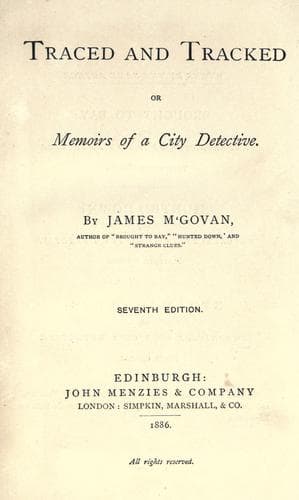
Traced and Tracked; Or, Memoirs of a City DetectiveM'Govan, James
General
Traced and Tracked; Or, Memoirs of a City Detective
M'Govan, James
Detective and mystery stories; Edinburgh (Scotland) -- Fiction
There is a great deal in a name. The lad Price had used the word
“footman” in describing the servant, probably because he had a vague
idea that any one was a footman who wore livery and opened a door.
It had never struck him to ask if there was any other man-servant in
the house, and it might not have struck me either if I had not seen
another—a valet—busy brushing his young master’s clothes in a bedroom
close to the apartment in which we conversed.
“Who is that brushing the clothes?” I asked of Mr Whitmore. “The
coachman?”
“Oh, no; the coachman does not live in the house while we are in
town; that’s my valet.”
“And what does he do?”
“Attends me—gets my clothes, helps me to dress—looks after
everything, and serves me generally.”
“Does he ever answer the door bell?”
“Really, I could not say,” was the answer, somewhat wearily given,
“but you may ask him.”
The gentleman, I could see, had a sovereign contempt for both me and
my calling, and was impatient to see me gone; but that, of course,
did not disturb me in the least.
I had the valet called in, and in reply to my question he gave me to
understand very clearly that answering the door bell “was not his
work,” but lay entirely between the footman and tablemaid.
“Supposing they were both out of the way, and you were near the door
when the bell rang, would you not answer it by opening the door?”
“No, certainly not.”
He appeared to think me very simple to ask such a question.
“Then who would open the door?”
“I don’t know; somebody else—it wouldn’t be me; but they wouldn’t be
both out of the way at once without leaving some one to attend the
door.”
“Just so; and that one might be you. Now don’t interrupt, and try to
carry your mind back five months, and to the 21st day of that month,
while your master here lay ill, and tell me if you did not answer the
door bell and take in a small parcel addressed to your master?”
“I wasn’t here five months ago, sir,” was the quick response; “I was
serving in the north then.”
“Indeed!” and I turned to his master in some surprise; “have you
discharged your valet within that time?”
“Oh, yes,” he lazily drawled; “I had Atkinson before him.”
“At the time you were ill?”
“Possibly so. I really don’t remember.”
“You did not tell me of this before.”
“No? Well, it doesn’t matter much, I suppose?”
I found it difficult to keep my temper. I had the lad Price brought
up from the hall, and he said most decidedly that the valet before us
was not the man who had taken in the parcel.
“Why did Atkinson leave you?” I resumed, to the master.
“He did not leave exactly. I was tired of him. He put on so many airs
that some thought that he was the master and I the man—fact, I assure
you. He was too fast, and conceited, and vain; and I thought—though
I’d be the last to say it—he wasn’t quite what you call honest, you
know.”
“Good-looking fellow?”
“Oh, passable as to that,” was the somewhat grudging reply. Mr
Whitmore himself was very ugly.
Public-domain text, read in full here on John Shaqi.
Reviews
Reviews
No reviews yet
Be the first to share your thoughts on this work.
Elsewhere in the archive
Join the Discussion
Join the discussion
Sign in to leave a comment or review.
Sign InorCreate an account